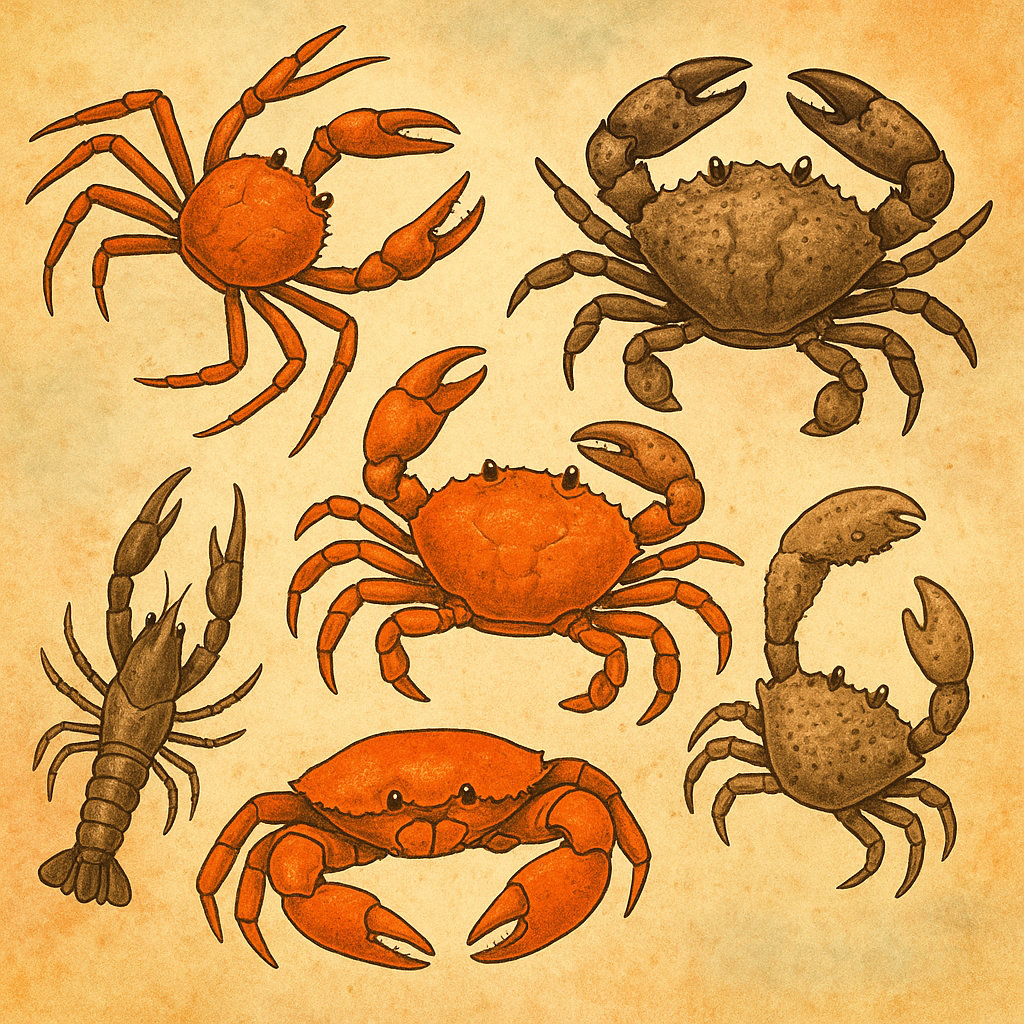
Crab People (C1)
Why Animals Keep Becoming Crabs – There is a funny joke on the internet. The joke says humans will become crabs one day. This sounds silly. But there is real science behind this joke. Scientists have found something very interesting about crabs.
Lexical Review & Practice
You can study the lexis now or after the audio
Listen to the article
Comprehension Questions
Answer these questions based on the audio you heard.
What is the main reason the internet joke about humans turning into crabs has scientific validity?
How many times has the crab body plan evolved independently in Earth’s history?
What distinguishes true crabs from their lobster and shrimp relatives in terms of body structure and habitat?
Which groups were mentioned as examples of “imposter crabs” that evolved crab-like features independently?
Why will humans never evolve into crabs, according to evolutionary biologists?
Which summary most accurately and comprehensively represents the audio?
Read the article for a more detailed understanding
📰 Why Evolution Keeps Reinventing the Crab (C1)
Test Your Understanding & Learn Vocabulary
Answer each question to reveal its vocabulary explanation:
In the article, ‘carcinisation’ refers to which biological process?
The term ‘decapods’ etymologically indicates organisms with which defining characteristic?
In the context of evolutionary biology, ‘convergent evolution’ describes which phenomenon?
When the article states the internet has ‘latched onto’ the idea of crabs, this phrasal verb conveys that people have…
The verb ‘scuttling’ in this context specifically describes which type of movement?
In academic writing, when something ‘exemplifies’ a concept, it…
In evolutionary biology, ‘lineages’ refers to…
An organism’s ‘ecological niche’ encompasses…
The defining characteristic that classifies organisms as ‘vertebrates’ is…
The verb ‘inhabit’ differs from the simpler ‘live in’ primarily in its…
When a trait is described as ‘advantageous’ in evolutionary contexts, it specifically means…
In this sentence “…allows their legs to move sideways, facilitating rapid escape…”, ‘facilitating’ most precisely means…
The phrase ‘a testament to’ in formal writing functions to…
The collocation ‘comprehensive suite of’ in academic discourse indicates…
In evolutionary biology, when organisms ‘sacrifice’ one trait for another, this describes…
Grammar Focus: Non-defining relative clauses with ‘which’
This group includes lobsters and shrimp, which possess long, cylindrical bodies with muscular tails.
In the sentence ‘This group includes lobsters and shrimp, which possess long, cylindrical bodies with muscular tails’, the clause after the comma is used to…
Grammar Focus: Present Perfect for actions continuing to present with observable results
Different groups of crustaceans, having faced similar challenges in their environments, independently evolved the same solution: a rounded shell and that distinctive sideways walk.
The use of ‘having faced’ (perfect gerund) in this sentence emphasizes that…
Grammar Focus
Non-defining relative clauses with ‘which’
“This group includes lobsters and shrimp, which possess long, cylindrical bodies with muscular tails.”
Pattern: Main clause + comma + which + verb + additional information
Function: Adds non-essential supplementary information about the noun, providing additional detail without restricting the meaning of the main clause. The clause can be removed without changing the core meaning.
Contrast with: Defining relative clauses (no commas) restrict meaning: ‘Crabs which live in shallow water’ (only those crabs) vs. ‘Crabs, which live in shallow water’ (all crabs, additional info). At C1 level, mastery of punctuation and meaning distinction is essential.
Present Perfect for actions continuing to present with observable results
“Different groups of crustaceans, having faced similar challenges in their environments, independently evolved the same solution: a rounded shell and that distinctive sideways walk.”
Pattern: Subject + have/has + past participle (often in participial clause form: 'having + past participle')
Function: Expresses completed actions in the past that have relevance to or results visible in the present situation. In perfect gerund form (‘having faced’), it emphasizes the temporal sequence: the facing of challenges preceded and led to the evolution.
Contrast with: Past Simple focuses on completed past action without present connection: ‘faced challenges and evolved’ (historical sequence). Present Perfect emphasizes the result or relevance: ‘have evolved’ (and we see the results now). Perfect gerund (‘having faced’) adds sophistication by compressing temporal relationships into participial phrases.
Grammar Focus Questions
Which sentence uses a defining relative clause with “which” correctly?
Complete the sentence with the correct present perfect participle clause: “_______ the novel three times, she felt confident discussing it in detail.”
In the sentence “The strategy which the team developed proved highly effective,” what function does the relative clause serve?
Which sentence contains an error with the present perfect participle clause?
Choose the sentence where “which” is used correctly in a defining relative clause:
What does the present perfect participle clause indicate in this sentence: “Having studied the data thoroughly, the researchers published their findings”?
Which sentence uses a defining relative clause with “which” appropriately?
What is wrong with this sentence: “Having been finished the assignment, I went to bed”?
In which situation would you use a defining relative clause with “which”?
Choose the sentence with the correctly formed present perfect participle clause:
Why is “which” used instead of “that” in formal academic writing: “The methodology which was employed in this study…”?
Which sentence correctly uses a present perfect participle clause to show cause and effect?
Identify the error in this defining relative clause: “The proposals which, the committee reviewed were all rejected.”
Complete the sentence: “_______ all the relevant literature, the student began writing the thesis.” Which form emphasizes that the reading was completed first?
Which sentence demonstrates the correct use of both a defining relative clause and appropriate punctuation?