Crab People? (A2)
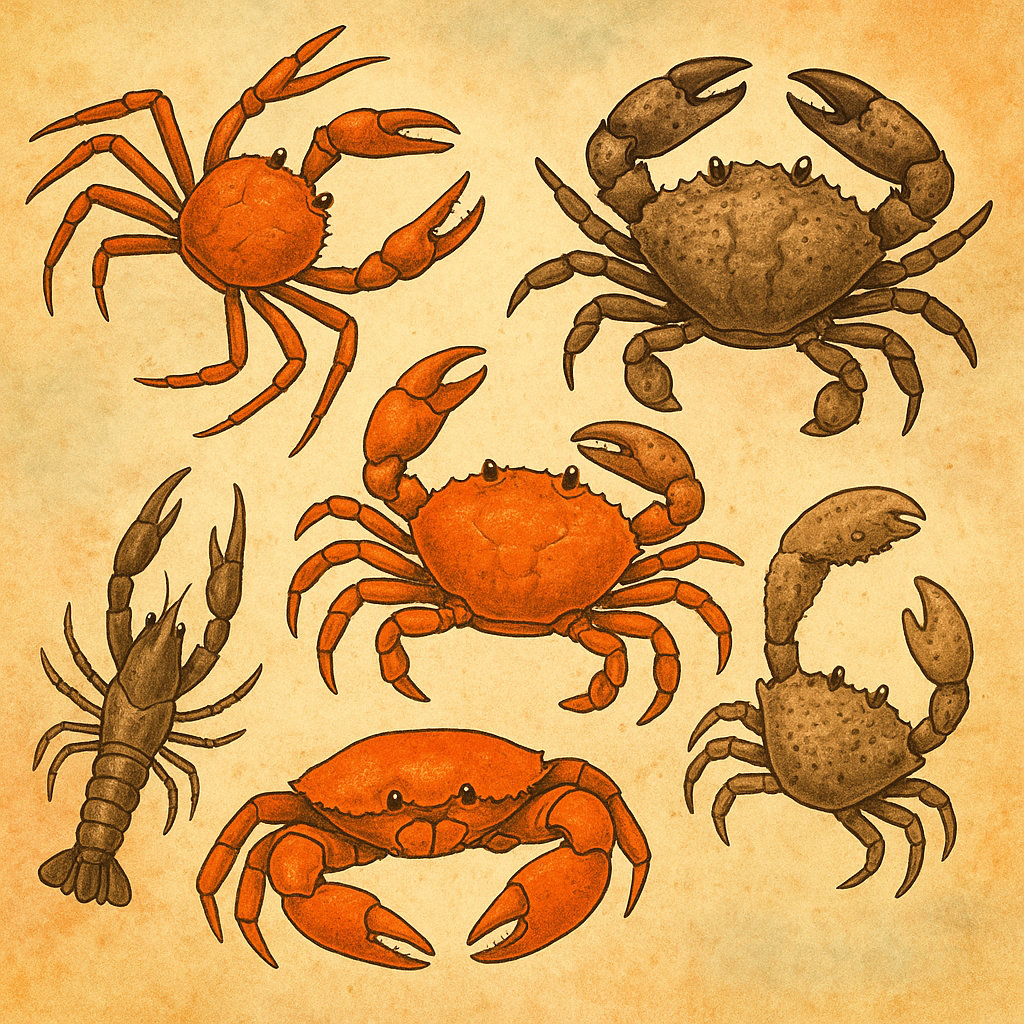
Why Animals Keep Becoming Crabs – There is a funny joke on the internet. The joke says humans will become crabs one day. This sounds silly. But there is real science behind this joke. Scientists have found something very interesting about crabs.
Listen to part 1 of the article
Comprehension Questions
Answer these questions based on the audio.
What is the main idea of this section of the report?
How many times has nature made animals become like crabs?
Listen to part 2 of the article
Comprehension Questions
Answer these questions based on the audio.
What is the main idea of this section?
Why do crabs have flat bodies?
Listen to part 3 of the article
Comprehension Questions
Answer these questions based on the report.
What is the main idea of part 3 of the report?
What did the imposter crabs lose during evolution?
Listen to part 4 of the article
Comprehension Questions
Answer these questions based on part 4.
What is the main message experts want people to understand?
How many times did convergent evolution of crabs happen?
Read the article for a more detailed understanding
📰 Why Animals Keep Becoming Crabs (A2)
Test Your Understanding & Learn Vocabulary
Answer each question to reveal its vocabulary explanation:
What does 'evolve' mean?
A predator is an animal that...
What does 'armor' mean?
When an animal 'escapes', it...
What is an 'ancestor'?
In the article, 'converge' means to...
What does 'compact' mean?
A 'crevice' is...
An 'expert' is someone who...
What is a 'vertebrate'?
If something is 'appealing', it is...
An animal's 'environment' is its...
What does 'effective' mean?
When something 'belongs to' a group, it...
To 'tuck under' something means to...
Grammar Focus: Modal 'can/cannot' for ability and possibility
So crabs can escape into small spaces between rocks.
In the sentence 'crabs can escape into small spaces', the word 'can' shows that crabs...
Grammar Focus
Modal 'can/cannot' for ability and possibility
"So crabs can escape into small spaces between rocks."
Pattern: Subject + can/cannot + base verb
Function: To express ability, possibility, or impossibility in the present
Contrast with: Could expresses past ability or more tentative possibility, while can expresses present ability or strong possibility
Grammar Focus Questions
Which sentence uses "can" correctly to express ability?
Complete the sentence: "I'm sorry, I _____ help you right now."
In the sentence "He can swim very fast," what does "can" express?
Which sentence contains an error with "can"?
Choose the correct negative form: "We _____ find the address."
Which sentence uses "could" correctly for tentative possibility?
What is wrong with this sentence: "She can cooks very well"?
Which sentence expresses possibility (not ability)?
Choose the correct question form with "can":
Why is "could" used instead of "can" in this sentence: "We could go to the park if it stops raining"?
Which sentence is correct?
Complete the sentence: "_____ you see the mountains from your window?"
What is the error in this sentence: "My brother can't to swim"?
Which sentence best completes this conversation? A: "Where's Tom?" B: "_____"
In which situation would you use "could" instead of "can"?