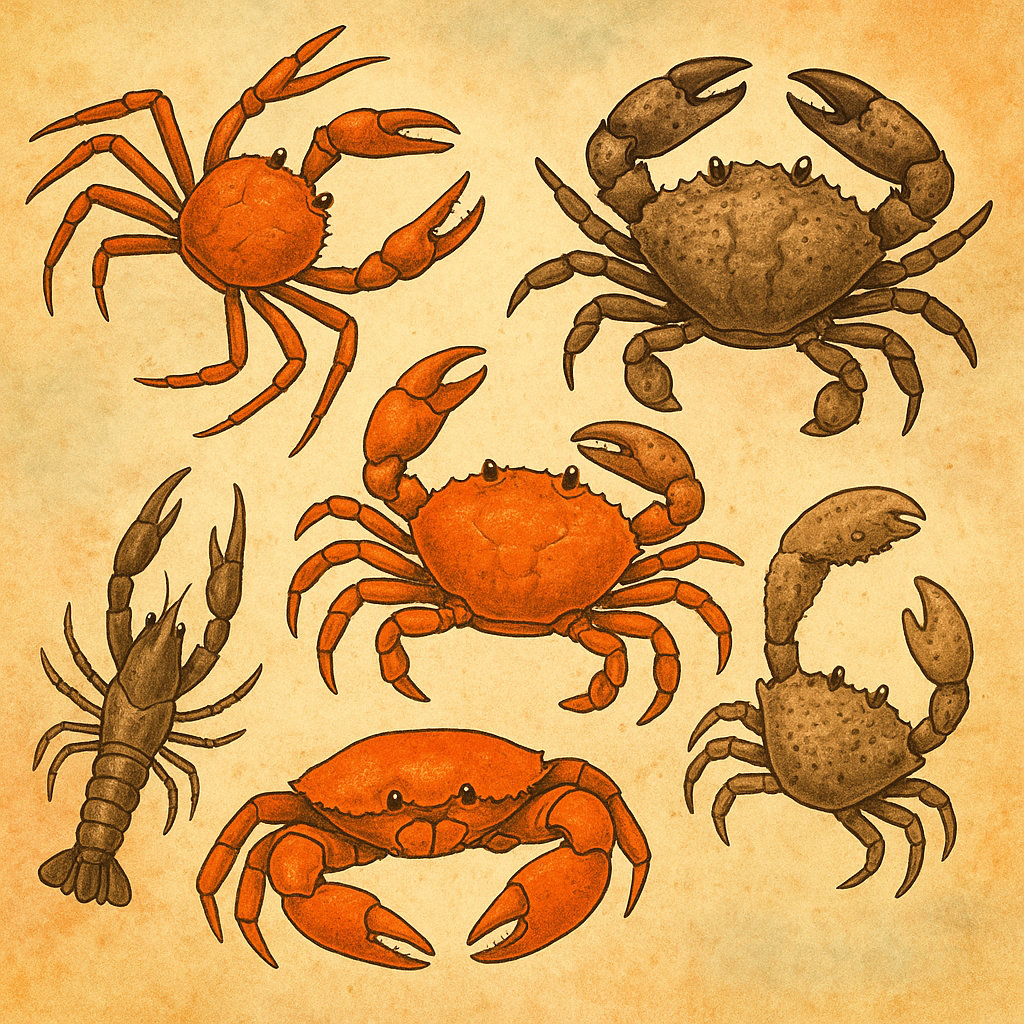
CRAB PEOPLE? (B1B2)
Why Evolution Keeps Reinventing the Crab – A joke has been spreading across the internet recently, and it suggests that humanity’s ultimate destiny isn’t to become cyborgs or upload our consciousness to the cloud. Instead, according to viral memes, we’re all eventually going to turn into crabs. The strange part is that there’s actually some real science behind this humorous idea.
Lexical Notes & Exercises
You can study the lexis now or after the audio
Listen to part 1 of the article
Comprehension Questions
Answer these questions based on the text.
What is the main scientific phenomenon that the text explains?
How many separate times has nature invented the crab body plan over millions of years?
Listen to part 2 of the article
Comprehension Questions
Answer these questions based on the audio you heard.
What is the main idea behind the internet joke mentioned in the audio?
How many times has nature independently evolved the crab body plan?
What does the term “decapods” mean?
Why do true crabs have a different body design than lobsters and shrimp?
What is convergent evolution, as described in the audio?
Which summary best captures the main points of the audio?
Read the article for a more detailed understanding
📰 Why Evolution Keeps Reinventing the Crab (B1/B2)
Test Your Understanding & Learn Vocabulary
Answer each question to reveal its vocabulary explanation:
In the sentence ‘humanity’s ultimate destiny isn’t to become cyborgs’, what does ‘destiny’ mean?
What does it mean to ‘upload our consciousness to the cloud’?
‘consciousness’ refers to…
When creatures ‘evolved’ a solution, they…
If different groups ‘independently evolved’ something, they did it…
A ‘distinctive’ sideways walk is one that is…
When creatures ‘inhabit’ a place, they…
A ‘compressed’ abdomen is one that has been…
A ‘vulnerable spot’ is a place that is…
A ‘predator’ is an animal that…
To ‘sacrifice’ something means to…
If you give up something ‘in exchange for’ something else, you…
‘Convergent evolution’ describes when…
If an idea is ‘appealing’, it is…
In biology, a ‘niche’ is…
Grammar Focus: Present Perfect with ‘has/have been’ + -ing (Present Perfect Continuous)
A joke has been spreading across the internet recently
Why does the article say ‘A joke has been spreading’ instead of ‘A joke spread’?
Grammar Focus: Non-defining relative clauses with ‘which’
The answer lies in something called carcinisation, which is the scientific term for becoming more crab-like.
In the sentence ‘carcinisation, which is the scientific term for becoming more crab-like’, the part after ‘which’…
Grammar Focus
Present Perfect with ‘has/have been’ + -ing (Present Perfect Continuous)
“A joke has been spreading across the internet recently”
Pattern: has/have + been + verb-ing
Function: Expresses an action that started in the past and continues to the present, often with ‘recently’, ‘lately’
Contrast with: Present Perfect Simple focuses on completion; Continuous emphasizes ongoing nature and duration
Non-defining relative clauses with ‘which’
“The answer lies in something called carcinisation, which is the scientific term for becoming more crab-like.”
Pattern: , which + verb + additional information
Function: Adds extra information about the preceding noun; can be removed without changing core meaning
Contrast with: Defining relative clauses (without commas) are essential to identify which thing/person is meant
Grammar Focus Questions
Which sentence uses the present perfect continuous correctly?
Complete the sentence: “She looks tired because she __________ all night.”
Which sentence indicates that the action is still in progress?
What is wrong with this sentence: “How long are you learning English?”
Choose the sentence that best expresses a repeated action over a period of time:
In this sentence, why is the present perfect continuous used? “My hands are dirty because I’ve been gardening.”
Which sentence contains an error with the present perfect continuous?
Choose the correct form: “I __________ five emails this morning.” (It’s still morning)
What is the difference between “I’ve read three books” and “I’ve been reading a lot”?
Which sentence is grammatically correct?
Complete the dialogue: A: “Why are you so sweaty?” B: “I __________.”
Which sentence correctly uses the present perfect continuous for emphasis on duration?
Choose the corrected version of this sentence: “How many times have you been visiting Paris?”
In which situation would you use the present perfect continuous instead of the present perfect simple?
What does the present perfect continuous emphasize in this sentence? “Scientists have been researching this disease for decades.”