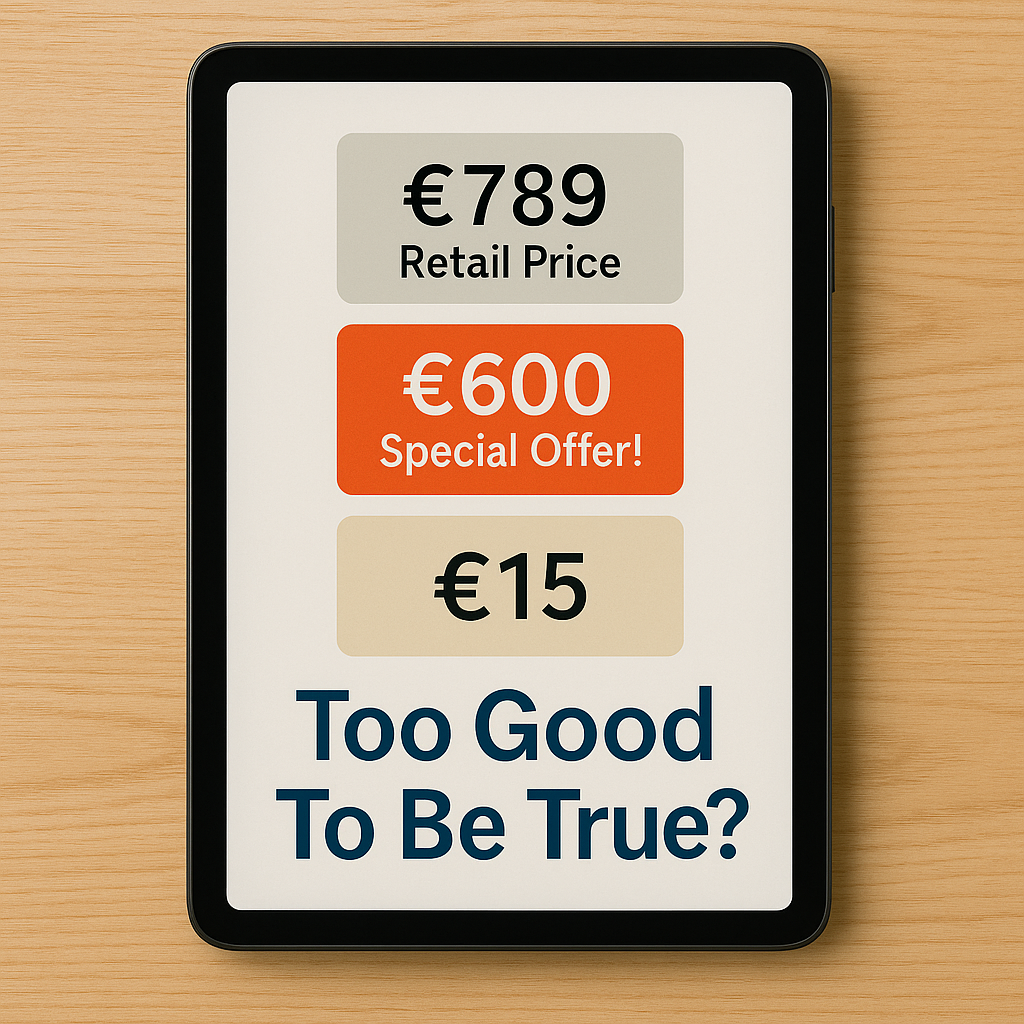
Too Good A Deal
Imagine this: you're scrolling through an electronics retailer's website during Black Friday season, and you spot a premium tablet. It normally costs around a thousand dollars, but it's listed for just seventeen dollars. This isn't a typo in the advertisement—it's the actual checkout price. Do you click buy? And if you do, can the company take it back later?
🔍 Listening Focus Questions
When a Deal Seems Too Good to Be True
Want to focus on some specifics while you listen? Read these questions before you press play.
- According to the audio, what was the original price of the tablet that was mistakenly listed?
- How long after the purchase did customers receive the retailer's email claiming the price was an error?
- Why does the audio suggest that modern retail has made pricing errors harder to identify as mistakes?
- What legal concept does the audio identify as central to determining whether a pricing mistake is binding?
- What distinguishes the casual shopper scenario from the bulk purchaser scenario in the audio's legal analysis?
- Which similar pricing error cases does the audio mention as examples?
- What does the audio suggest is the most significant aspect of this particular case for students of contract law?
🎧 Too Good A Deal C1
Comprehension Check: When a Deal Seems Too Good to Be True
Answer the questions based on what you heard in the audio.
According to the audio, what was the original price of the tablet that was mistakenly listed?
How long after the purchase did customers receive the retailer's email claiming the price was an error?
Why does the audio suggest that modern retail has made pricing errors harder to identify as mistakes?
What legal concept does the audio identify as central to determining whether a pricing mistake is binding?
What distinguishes the casual shopper scenario from the bulk purchaser scenario in the audio's legal analysis?
Which similar pricing error cases does the audio mention as examples?
What does the audio suggest is the most significant aspect of this particular case for students of contract law?
Which of these two summaries best captures the main points of the audio?
📰 When a Deal Seems Too Good to Be True (C1)
Test Your Understanding & Learn Vocabulary
Answer each question to reveal its vocabulary explanation:
In the sentence ‘Not a typo in the ad copy, but an actual checkout price’, what does ‘the ad copy’ refer to?
In the sentence ‘This exact scenario played out recently at a major European electronics chain’, ‘played out’ means:
What does ‘glitch’ mean in the context of the article?
‘Albeit’ could be replaced with which word or phrase (They offered two options: pay most of the original price to keep the tablet, albeit with a modest discount, or return it for a refund plus a small voucher.)?
In the sentence ‘This situation raises a fascinating legal question: when is a price mistake actually binding?’, what does ‘binding’ mean?
What does ‘recognizability’ refer to in this legal context?
In the sentence ‘Today, flash sales, app-only deals, and viral marketing stunts have made extreme discounts part of the landscape’, ‘stunts’ refers to:
What is ‘a loss-leader’ in business terminology?
In the sentence ‘The legal analysis often turns on the buyer’s sophistication’, ‘turns on’ means:
What does ‘amiss’ mean in this context?: “The second buyer’s recognition of the error seems more obvious, suggesting they should have realized something was amiss.”
In the sentence ‘In some jurisdictions, courts have sided with consumers’, what does ‘jurisdictions’ refer to?
In the sentence ‘In others, judges have allowed sellers to void transactions when errors are sufficiently extreme’, ‘void’ means:
What does ‘fraud’ mean in this legal context: “It’s not clearly fraud by the buyer—most purchased just one item for personal use.”
In the sentence ‘It sits in that uncomfortable middle ground where reasonable people disagree about what’s fair and what’s legal’, ‘middle ground’ refers to:
What is ‘a voucher’ in retail contexts?
📚 Vocabulary Deep Dive
C1 Too Good To Be True
📖 Complete Vocabulary Reference
All vocabulary items organized by theme:
Commercial and Legal Terms
Terms relating to business transactions, contracts, and legal frameworks
Legally obligatory; creating a duty or obligation that must be fulfilled according to law
📝 “Once you sign the contract, it becomes a binding agreement that both parties must honor.”
A document that can be exchanged for goods, services, or a discount; a coupon or token of value
📝 “The company issued vouchers worth €50 to customers affected by the service disruption.”
Not legally valid or binding; having no legal force or effect; null
📝 “The warranty becomes void if you attempt to repair the device yourself.”
The official power to make legal decisions and judgments; the geographical areas or systems where particular laws apply
📝 “This offer is only valid in certain jurisdictions and may not apply in your country.”
Criminal deception intended to result in financial or personal gain; wrongful or criminal deception
📝 “The company was investigated for fraud after customers discovered the products didn't match the advertised claims.”
Marketing and Advertising Terms
Vocabulary specific to promotional strategies and commercial communication
The written text or wording used in an advertisement to persuade or inform potential customers
📝 “The ad copy was carefully crafted to highlight the product's unique benefits without making false claims.”
The quality of being easily identified or recognized; the degree to which something is familiar or distinctive
📝 “Brand recognizability is crucial for marketing success in competitive markets.”
Actions or schemes designed to attract attention, often unusual or sensational promotional activities
📝 “The company's marketing stunts included giving away free products to the first 100 customers.”
A product sold at a loss to attract customers who will then purchase other profitable items
📝 “The supermarket used milk as a loss-leader, selling it cheaply to bring customers into the store.”
Descriptive and Evaluative Terms
Words describing states, conditions, or assessments of situations
Exhausted, overused, or no longer interesting or effective; worn out through repetition
📝 “That marketing strategy is completely played out; consumers are tired of seeing the same approach.”
Wrong, inappropriate, or not as it should be; indicating something is faulty or improper
📝 “Something seemed amiss when the advertised price was 90% lower than usual.”
A compromise position between two extremes; an area of agreement or acceptable solution between opposing views
📝 “Regulators are trying to find a middle ground between protecting consumers and allowing business flexibility.”
Functional and Connecting Terms
Words that express conditions, dependencies, or technical malfunctions
A sudden, usually temporary malfunction or irregularity, especially in technology or systems
📝 “The website's pricing showed €1 instead of €100 due to a technical glitch.”
Although; even though; used to introduce a contrasting statement that modifies what was just said
📝 “The offer was genuine, albeit with several conditions that limited its value.”
Depends on; hinges on; is determined or decided by a particular factor or condition
📝 “Whether the contract is valid turns on the specific wording in the terms and conditions.”
🎮 Practice Activities
Word Formation
Complete the sentences using the correct form of the word in brackets. You may need to add prefixes or suffixes.
The company's logo has high __________ among consumers in the target market.
The CEO was charged with __________ misrepresenting the company's financial position.
Once both parties sign, the contract becomes legally __________.
The warranty is __________ if the product is used for commercial purposes.
Customers can __________ their vouchers at any branch before the expiry date.
Collocation Matching
Match the words on the left with their correct collocations on the right
Gap Fill
Complete each sentence with ONE word from the box. Each word can be used only once.
Something seemed __________ when the luxury watch was advertised for only €10.
The entire case __________ on whether the company intentionally misled customers.
The pricing error was caused by a technical __________ in the website's database.
The company was prosecuted for __________ after selling fake designer products.
Consumer protection laws vary significantly across different __________.
Gap Fill Multiple Choice
Choose the correct word or phrase to complete each sentence
Supermarkets often use basic items like bread as __________ to attract customers.
Error Correction
Each sentence contains ONE error related to the target vocabulary. Find and correct it.
❌ The contract becomes completely binding once both signatures are added.
❌ The company's marketing stunts were getting played off and no longer generated buzz.
❌ The decision turns on next week after the board meeting.
❌ Customers need to vouch their gift vouchers before the expiration date.
❌ The two sides tried to make middle ground but negotiations failed.