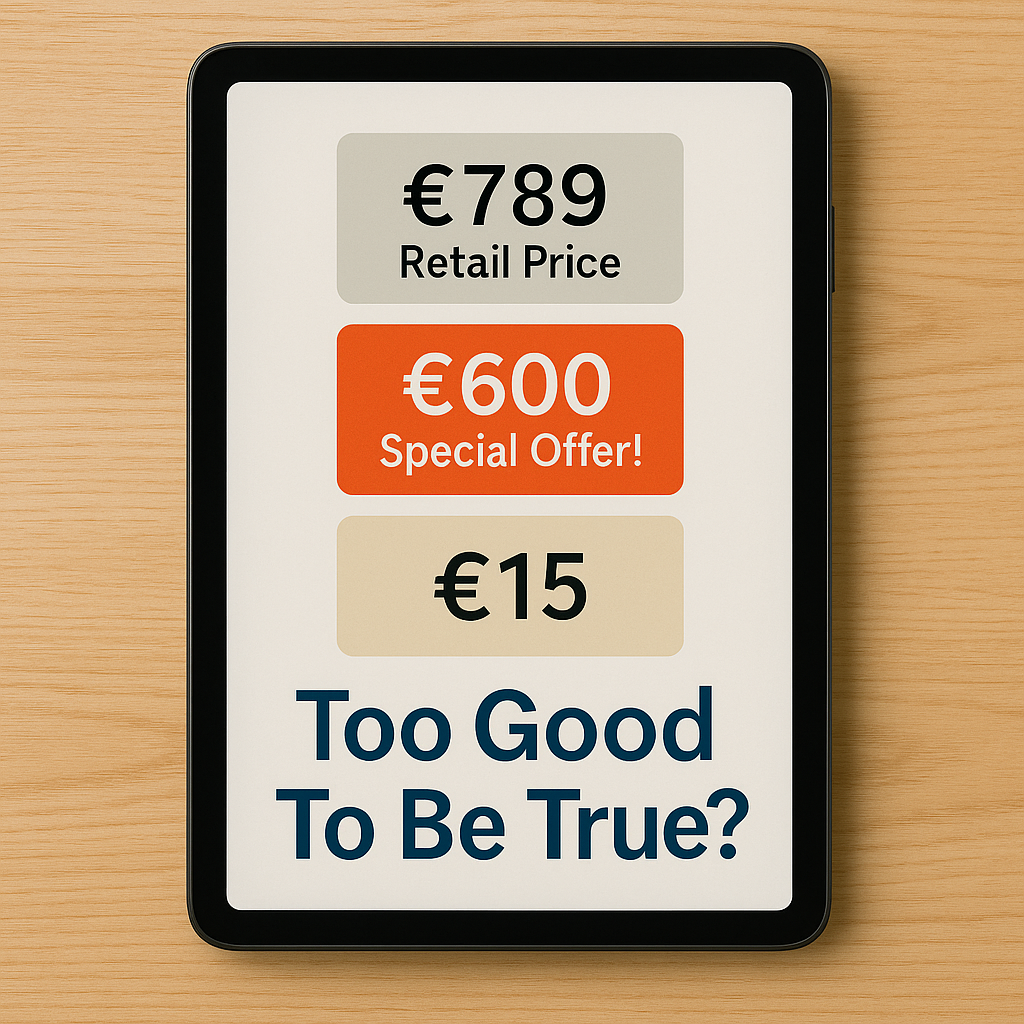
Too Good A Deal
Imagine this: you're scrolling through an electronics retailer's website during Black Friday season, and you spot a premium tablet. It normally costs around a thousand dollars, but it's listed for just seventeen dollars. This isn't a typo in the advertisement—it's the actual checkout price. Do you click buy? And if you do, can the company take it back later?
🔍 Listening Focus Questions
When a Deal Seems Too Good to Be True
Want to focus on some specifics while you listen? Read these questions before you press play.
- According to the audio, what was the original price of the tablet that was listed at seventeen dollars?
- How long after customers received their tablets did the retailer send an email about the error?
- Why does the audio suggest that extreme discounts are harder to recognize as errors today than twenty years ago?
- What two scenarios does the audio compare to illustrate buyer sophistication?
- What is the main legal concept that determines whether a pricing error creates a binding contract?
🎧 Too Good A Deal B1B2
Comprehension Check: When a Deal Seems Too Good to Be True
Answer the questions based on what you heard in the audio.
According to the audio, what was the original price of the tablet that was listed at seventeen dollars?
How long after customers received their tablets did the retailer send an email about the error?
Why does the audio suggest that extreme discounts are harder to recognize as errors today than twenty years ago?
What two scenarios does the audio compare to illustrate buyer sophistication?
What is the main legal concept that determines whether a pricing error creates a binding contract?
Which of these two summaries best captures the main points of the audio?
📰 When a Deal Seems Too Good to Be True (B1/B2)
Test Your Understanding & Learn Vocabulary
Answer each question to reveal its vocabulary explanation:
In the sentence ‘And if you do, can the company take it back later?’, what does ‘take it back’ mean?
What does ‘listed at’ mean in a retail context?
In the sentence ‘Customers ordered online and chose in-store pickup’, what does ‘in-store pickup’ refer to?
‘Handed over’ means…
In the sentence ‘The retailer claimed the price was clearly an error—a technical glitch on their platform’, what is a ‘glitch’?
What is a ‘voucher’ in a retail context?
In the sentence ‘the retailer completed the transactions, accepted payment, and handed over products before raising any objection’, ‘raising’ means…
What does ‘binding’ mean in a legal context?
In the sentence ‘Many legal systems allow contracts to be voided if an error is both fundamental and recognizable’, ‘voided’ means…
What does ‘retail’ refer to?
In the sentence ‘flash sales, app-only deals, and viral marketing stunts have made extreme discounts part of the landscape’, what are ‘flash sales’?
What are ‘stunts’ in a marketing context?
In the sentence ‘a casual shopper spots the deal, thinks they’ve gotten lucky, and buys one tablet’, what is ‘a casual shopper’?
‘Sided with’ could be replaced with which phrase?
In the sentence ‘That’s different from catching an error before fulfillment and canceling orders’, what does ‘catch an error’ mean?
📚 Vocabulary Deep Dive
b1b2 Too Good To Be True
📖 Complete Vocabulary Reference
All vocabulary items organized by theme:
Retail Transaction Terms
Terms related to purchasing, pricing, and commercial processes
shown or displayed at a particular price
📝 “The laptop was listed at £299, but it was worth much more.”
a service where you collect an item from a physical shop after ordering online
📝 “I chose in-store pick up to avoid delivery charges.”
a document that can be exchanged for goods, services, or a discount
📝 “The company offered customers a £10 voucher as compensation.”
the sale of goods to the public in shops or online
📝 “She works in retail and knows all about customer service.”
very short promotional sales offering steep discounts for a limited time
📝 “The website runs flash sales every Friday at midnight.”
Action Verbs – Returns and Exchanges
Verbs describing customer service actions and transaction modifications
to return something to a shop for a refund or exchange
📝 “If the product is faulty, you can take it back within 30 days.”
gave something to someone, especially officially or formally
📝 “The customer handed over the receipt and requested a refund.”
to bring up or mention a problem, issue, or concern
📝 “Several customers raised complaints about the pricing error.”
to notice or discover a mistake
📝 “The manager didn't catch the error until hundreds of orders were placed.”
Legal and Technical Terms
Terms related to contracts, technical problems, and legal decisions
a temporary technical problem or error in a system
📝 “A glitch in the website caused all prices to show as £1.”
legally required to be obeyed or followed
📝 “The court ruled that the advertised price was a binding contract.”
cancelled or made invalid
📝 “The company voided all orders placed during the pricing error.”
supported or agreed with one person or group in a disagreement
📝 “The judge sided with the customers and ordered refunds.”
Consumer Types and Marketing Tactics
Terms describing customer profiles and promotional strategies
someone who shops occasionally without serious intent or planning
📝 “Even casual shoppers noticed the incredible deal and started ordering.”
actions designed to attract attention, often for publicity or marketing
📝 “Some people thought the pricing error was a marketing stunt.”
🎮 Practice Activities
Word Formation
Complete the sentences using the correct form of the word in brackets. Use the vocabulary from the text.
The company's decision to honour the prices was legally _____ .
All orders placed during the error were _____ by the company.
The _____ refused to accept returns without a receipt.
Many customers _____ their receipts to claim refunds.
The website experienced a technical _____ during the sale.
Collocation Matching
Match the words from column A with their common partners in column B to form collocations from the text.
Gap Fill
Complete each sentence with ONE word from the box. Use each word only once.
The court _____ with the consumers and ordered full refunds.
A technical _____ caused all items to show incorrect prices on the website.
The customer _____ over the faulty product and demanded a replacement.
Many shoppers wanted to _____ complaints about the cancelled orders.
The company claimed the advertised price was not legally _____.
Gap Fill Multiple Choice
Choose the correct word or phrase to complete each sentence.
The laptop was _____ £299, but it was actually worth over £1,000.
I chose _____ to avoid paying delivery charges.
If you're not satisfied, you can _____ to the shop within 14 days.
The manager didn't _____ the pricing error until it was too late.
Some customers believed the pricing error was a publicity _____.
She works in _____ and deals with customer complaints every day.
The company offered affected customers a £10 _____ as compensation.
The website runs _____ every Friday with huge discounts for one hour only.
Error Correction
Each sentence contains ONE mistake with the vocabulary from the text. Find and correct it.
❌ The product was listed for £50 but the real price was £500.
❌ I need to take back it to the shop because it's broken.
❌ The judge sided the customers in the legal dispute.
❌ The contract was not binded so the company could cancel it.
❌ Several customers raised their complaints about the service.