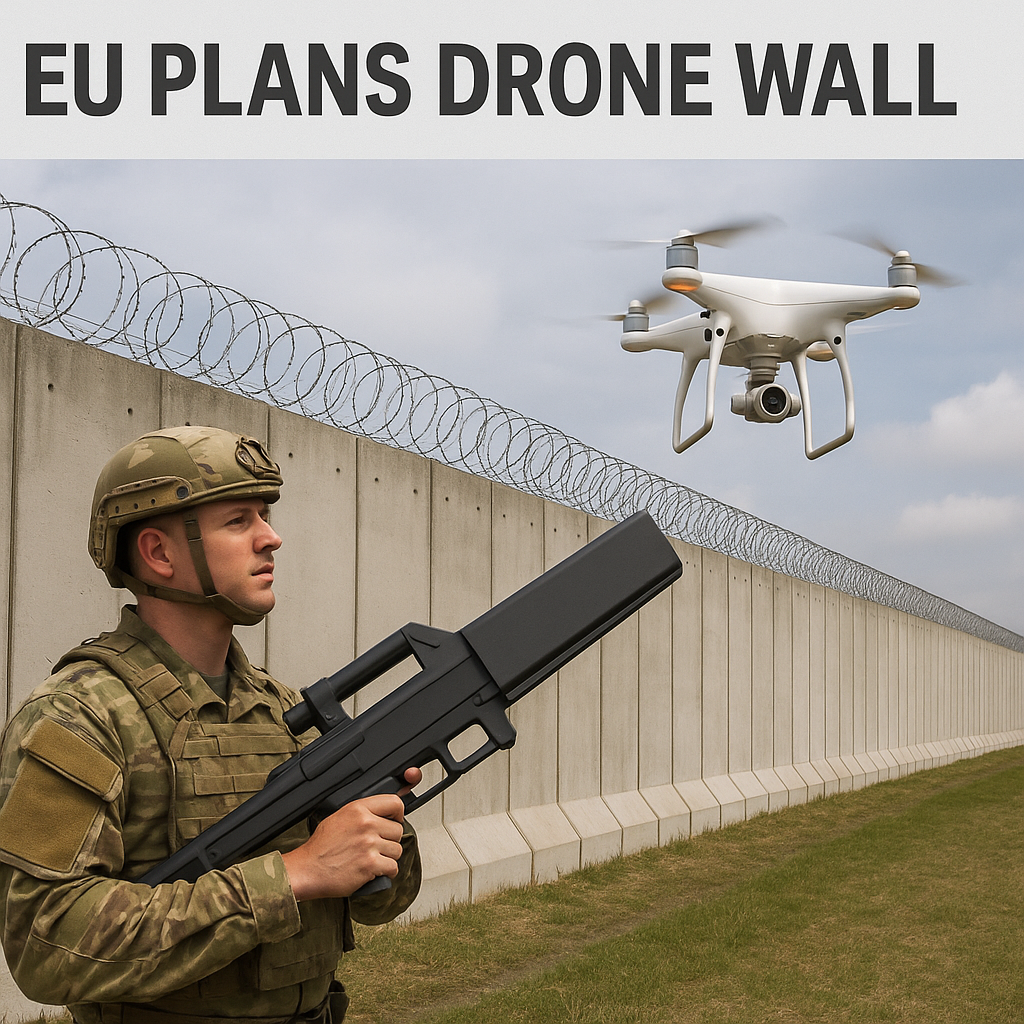
EUROPE PLANS TO BUILD A 'DRONE WALL'
The European Union has agreed to build a 'drone wall' to protect its eastern borders from airspace violations.
EU Plans Drone Wall and Major Loan for Ukraine (B1/B2)
Listen to the report
Now read the story and check your comprehension
📰 EU Plans Drone Wall and Major Loan for Ukraine (B1/B2)
Test Your Understanding & Learn Vocabulary
Answer each question to reveal its vocabulary explanation:
In the sentence ‘The EU has decided to move forward with plans for a drone wall’, what does ‘move forward with’ mean?
When the text says ‘momentum is growing’ for a proposal, it means…
What are ‘frozen assets’ in a financial context?
In this context “The issue has become more urgent after a series of drone incursions in Denmark, Poland and Romania” ‘incursions’ refers to…
What does ‘violation’ mean in the phrase ‘airspace violations’?
To ‘intercept’ drones means to…
When someone ‘acknowledges’ a problem, they…
If an action is described as ‘reckless’, it means the person…
To ‘confiscate’ funds means to…
“Germany, France and Belgium have resisted plans from central and eastern European countries to seize the assets.” In this context, ‘seize the assets’ means to…
“EU leaders are expected to discuss the drone wall and reparations loan at a Copenhagen summit next week” What are ‘reparations’ in this context?
When a leader ‘swings behind’ an idea, it means they…
In the sentence ‘This would secure Ukraine’s military resilience’, what does ‘resilience’ refer to?
“The EU’s sanctions against Russia must be renewed every six months. This gives Budapest significant leverage,…” What does ‘leverage’ mean in this political context?
A ‘guarantor’ is someone who…
Grammar Focus: Present Perfect for recent developments and current relevance
The European Union has agreed to build a ‘drone wall’ to protect its eastern borders from airspace violations.
Why does the text use ‘The European Union has agreed’ instead of ‘The European Union agreed’?
Grammar Focus: Passive voice for formal reporting and focus on action/recipient
These assets are largely held at the Brussels-based financial institution Euroclear.
In the sentence ‘These assets are largely held at the Brussels-based financial institution’, the passive voice is used to…
Grammar Focus
Present Perfect for recent developments and current relevance
“The European Union has agreed to build a ‘drone wall’ to protect its eastern borders from airspace violations.”
Pattern: Subject + have/has + past participle
Function: Connects past actions to present situation; emphasizes current relevance of recent decisions
Contrast with: Past Simple focuses on completed past actions without connection to present
Passive voice for formal reporting and focus on action/recipient
“At the same time, momentum is growing for a €140 billion loan to Ukraine using frozen Russian assets.”
Pattern: Subject + be + past participle (+ by agent)
Function: Shifts focus to action or recipient; maintains formal register; agent may be unknown or unimportant
Contrast with: Active voice emphasizes the agent/doer of the action