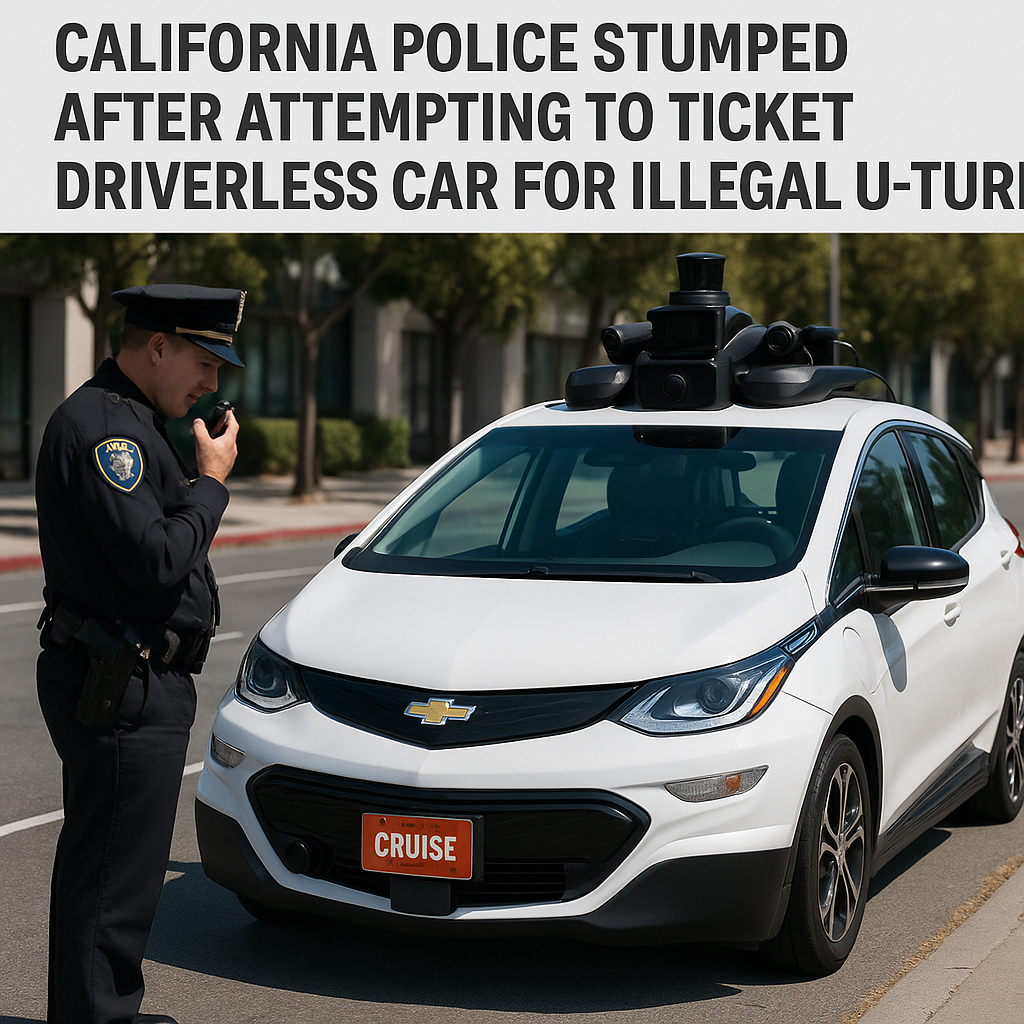
CAN A DRIVERLESS CAR BE FINED
Police Can’t Give Ticket to Driverless Car After Illegal Turn (B1/B2)
Listen to a report about the story
Listen out specifically for this lexis and try to understand it in context: pull over, behind the wheel, autonomous, issue a ticket, software, keep from, be committed to, go into effect, first responders, interfere with, lenient, in the works, operate through, recall, catch up with
Before you read the story (blue box below), make some notes about what you think the main events of the story are – then check your notes with the story!
📰 Police Can’t Give Ticket to Driverless Car After Illegal Turn (B1/B2)
Test Your Understanding & Learn Vocabulary
Answer each question to reveal its vocabulary explanation:
When police ‘pull over’ a vehicle, they…
If someone is ‘behind the wheel’, they are…
An ‘autonomous’ vehicle is one that…
When police ‘issue a ticket’, they…
What does ‘software’ refer to?
In this sentence, ‘keep it from making illegal moves’ means…
When a company is ‘committed to improving’ something, it means they are…
When a law ‘goes into effect’, it…
‘First responders’ are…
If something ‘interferes with’ firetrucks, it…
If someone is ‘lenient’, they are…
When something is ‘in the works’, it is…
When vehicles ‘operate through’ cameras and sensors, they…
When a company ‘recalls’ vehicles, it…
When the legal system is ‘catching up with’ technology, it is…
Grammar Focus: Passive voice (modal + be + past participle)
Since there was no human driver, a ticket couldn’t be issued (our citation books don’t have a box for ‘robot’).
In the sentence ‘a ticket couldn’t be issued’, the passive voice is used to…
Grammar Focus: Relative clauses (defining and non-defining)
The car was a Waymo, which is the most popular self-driving taxi service in the San Francisco Bay Area.
Why is there a comma before ‘which’ in this sentence?
Grammar Focus
Passive voice (modal + be + past participle)
“Since there was no human driver, a ticket couldn’t be issued (our citation books don’t have a box for ‘robot’).”
Pattern: modal verb + be + past participle
Function: To describe actions when the doer is unknown, unimportant, or when focusing on the action rather than the agent; common in formal/news contexts
Contrast with: Active voice would be ‘officers couldn’t issue a ticket’ – passive shifts focus to the action/object
Relative clauses (defining and non-defining)
“The car was a Waymo, which is the most popular self-driving taxi service in the San Francisco Bay Area.”
Pattern: noun + which/that/who + verb phrase (with/without commas)
Function: To add essential or extra information about a noun; non-defining clauses (with commas) add bonus information, defining clauses (no commas) identify which specific thing
Contrast with: Defining: ‘cars that drive themselves’ (which cars?); Non-defining: ‘Waymo, which is popular’ (extra info about Waymo)