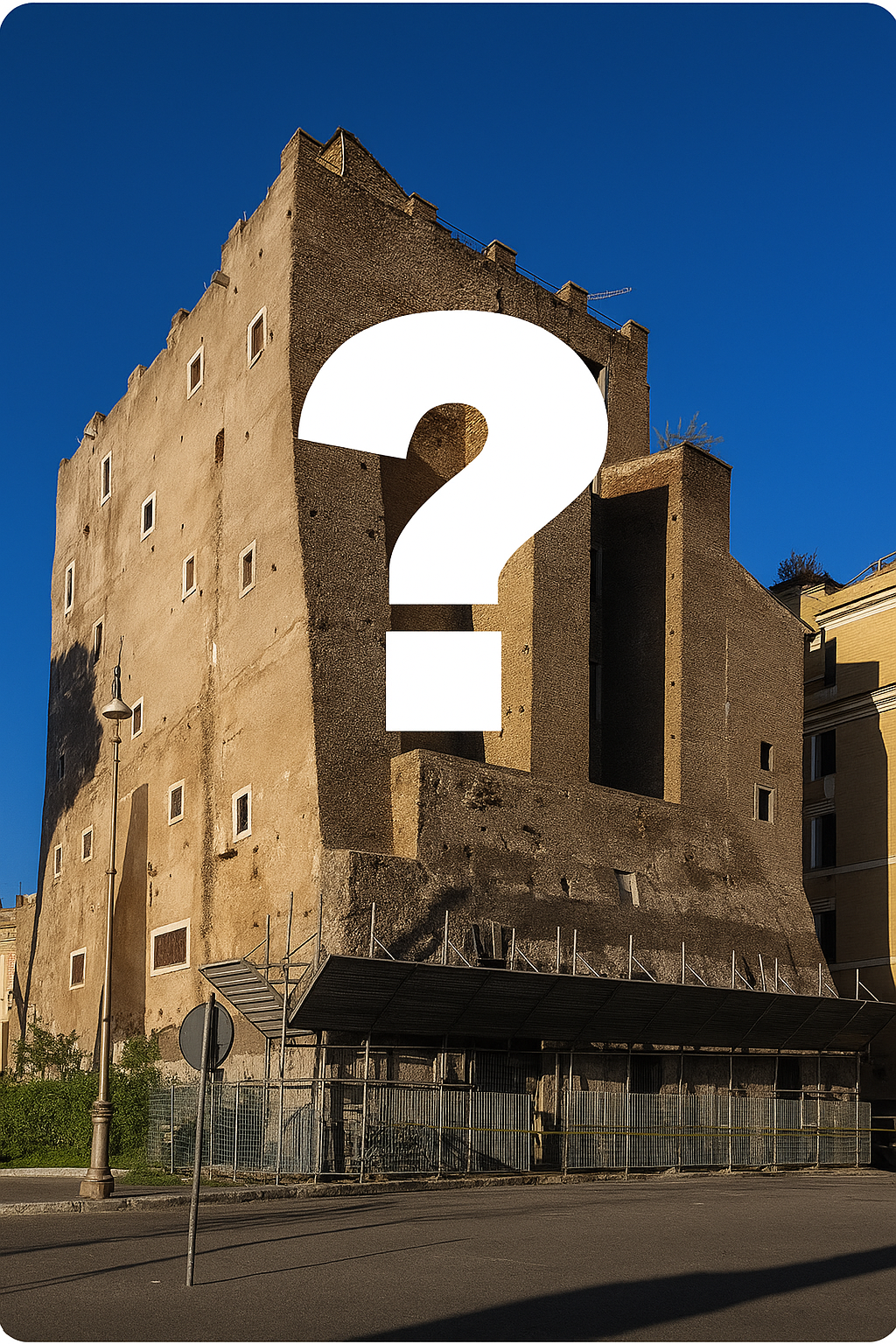
The Fall of Torre dei Conti: Investigating the Collapse of an Eight-Century Survivor (C1)
The Torre dei Conti had withstood centuries of earthquakes, now the remarkable survivor of Roman history has been severely damaged
🎧 Torre Dei Conti Partial Collapse
Comprehension Questions
Answer these questions based on the audio.
What is the primary focus of the investigation following the collapse?
How long did the tower remain empty before renovation work began in 2022?
📰 The Fall of Torre dei Conti: Investigating the Collapse of an Eight-Century Survivor (C1)
Test Your Understanding & Learn Vocabulary
Answer each question to reveal its vocabulary explanation:
In the sentence 'Now, investigators are attempting to understand what might have caused an eight-hundred-year-old survivor to suddenly give way', what does 'give way' mean?
In the sentence 'The Torre dei Conti had withstood centuries of earthquakes', what does 'withstood' convey that 'resisted' would not?
What does 'fortified residence' mean?
'Seismic activity' could be replaced with which phrase?
In the sentence 'it served as a symbol of medieval power rising from classical ruins, a testament to the engineering capabilities of its era', what does 'testament' mean?
What are 'buttresses' in architectural terms?
In the sentence 'Modern urban development, however, fundamentally altered the tower's context', what does 'fundamentally altered' imply?
What does 'deterioration' mean?
In the sentence 'raising urgent questions about what had triggered such catastrophic failure', the term 'catastrophic failure' indicates what kind of breakdown?
What does 'destabilized' mean in this engineering context?
'Water infiltration' could be replaced with which phrase?
In the sentence 'The earthquake history presents another, more insidious possibility', what does 'insidious' convey?
What does the phrase 'accumulated over time' emphasize?
In the sentence 'the structural vulnerabilities might have been identified before renovation work commenced', what does 'structural vulnerabilities' mean?
In the sentence 'seeking answers that may reshape how Italy approaches the restoration of its ancient monuments', what does 'reshape' mean?
Grammar Practice
Why does the author use 'could have destabilized' rather than 'destabilized' when discussing the renovation work's effect on the tower?
In the sentence 'The Torre dei Conti had withstood centuries of earthquakes, having been built in 1238', what does the past perfect structure 'had withstood' establish?
Reading Comprehension
According to the article, when was the Torre dei Conti originally built?
What can be inferred about the sixteen-year period of abandonment between 2006 and 2022?
⚖️ Modal Perfect Forms vs Simpler Alternatives
Now try these questions:
Which sentence correctly uses must have been to express a logical deduction about a past continuous action?
In the sentence “The lights are off and nobody’s answering—they ______ out,” which modal perfect best expresses possibility?
What is the error in this sentence: “She couldn’t have been knowing about the surprise party”?
Which sentence uses should have been + -ing to express criticism about an action that didn’t happen?
Complete the sentence with the appropriate modal perfect: “The streets are completely dry, so it ______ last night after all.”
In this context, what does might have been express: “I might have been a professional musician if I’d practiced more as a child”?
Which sentence contains an error with modal perfect continuous form?
Choose the sentence where couldn’t have is used correctly to express impossibility:
What is the difference in meaning between “He may have left” and “He might have left”?
Complete with the most appropriate modal: “You look exhausted! You ______ all night to finish that presentation.”
Which sentence correctly uses ought to have to express past obligation?
In the sentence “She mightn’t have received the email yet—the server was down earlier,” what does mightn’t have express?
Identify the error: “He shouldn’t have been understanding the instructions—they were in a foreign language.”
Which modal perfect best completes this sentence: “The house is spotless—the cleaners ______ here all morning”?
Choose the sentence where could have been expresses an unrealized past possibility (not speculation):