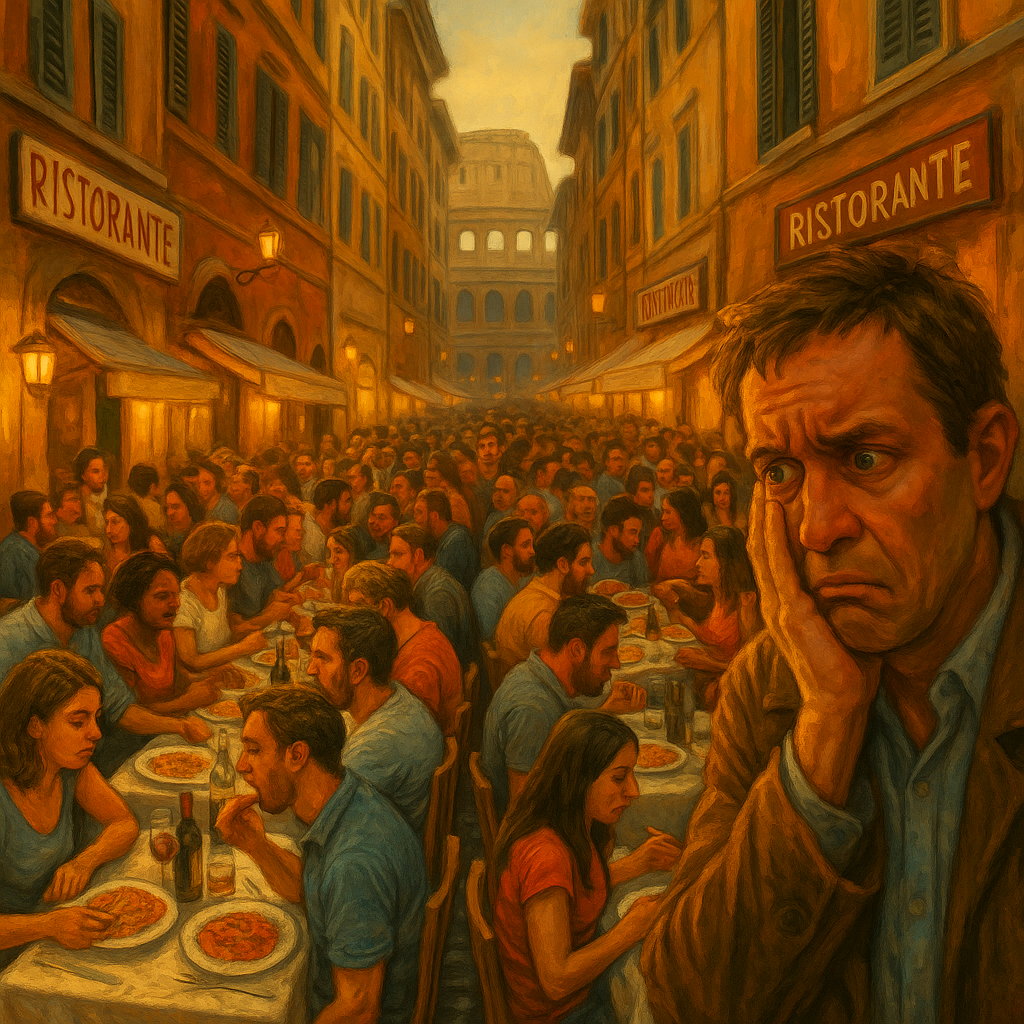
Food Park Italy (C1)
When Too Much Pasta Becomes a Problem: Italian Cities Fight Food Tourism Overload – icture this: thirty-one restaurants crammed onto a single street in Palermo, Sicily. Fluorescent orange Aperol spritzes on every table. Deep-fried rice balls and cannoli as far as the eye can see. For tourists, it’s paradise. For the mayor of Palermo, it was finally too much. He’s banned new restaurants from opening in the historic center. And he’s not alone.
Listen to the article
Comprehension Questions
Answer these questions based on the audio you heard.
What is the primary concern that prompted Palermo’s mayor to ban new restaurant openings in the historic center?
What significant event in 2015 accelerated the transformation of Palermo’s historic center?
How much has Rome’s historic center population changed over the past fifteen years?
What term have experts coined to describe the food-based transformation of Italian urban centers?
According to the audio, what percentage of Italy’s economy does tourism now represent?
What contradiction does the Palermo tour guide experience in her relationship with tourism?
How does the former university director in Pisa frame Italy’s economic challenge?
Which summary most accurately and comprehensively represents the audio?
Read the article for a more detailed understanding
📰 When Too Much Pasta Becomes a Problem: Italian Cities Fight Food Tourism Overload (C1)
Test Your Understanding & Learn Vocabulary
Answer each question to reveal its vocabulary explanation:
In the sentence ‘tourism starts to hollow out the very authenticity’, the phrasal verb ‘hollow out’ means to:
The author’s use of ‘authenticity’ in this context emphasizes:
The neologism ‘foodification’ is constructed to convey:
In academic discourse, ‘gentrification’ specifically refers to:
When the article states tourism provides her ‘livelihood’, it means:
The phrase ‘tells this story in miniature’ suggests the market:
Describing something ‘bluntly’ indicates the speaker is:
In an economic context, ‘to diversify’ means to:
The phrase ‘remarkable candor’ suggests the acknowledgment was characterized by:
Describing the scene as ‘apocalyptic’ conveys a sense of:
The adjective ‘ostentatious’ implies that a celebration is:
The term ‘brain drain’ refers to:
Using ‘monocultures’ metaphorically in an urban context suggests:
When something becomes ‘synonymous with’ something else, it means:
The abstract noun ‘inauthenticity’ denotes:
Grammar Practice
Why does the article use ‘Florence has gone even further’ rather than ‘Florence went even further’?
The structure ‘has lost…over the past fifteen years’ (rather than ‘lost…fifteen years ago’) is chosen to convey:
Reading Comprehension
According to the article, what measure has Florence implemented to address tourism’s impact?
The social worker’s comparison of the celebration to Pompeii suggests she views the current situation as:
Grammar Exercises
Which sentence correctly uses the present perfect simple to express a gradual change over time?
Complete the sentence: “Global temperatures __________ by 1.2 degrees Celsius since the pre-industrial era.”
Which sentence uses the present perfect continuous correctly to emphasize ongoing change?
What is the error in this sentence: “The population has been increasing by 3 million people since 2010”?
In this context, why is the present perfect simple used? “Property prices have doubled in the last five years.”
Which sentence correctly emphasizes the continuous nature of change using an action verb?
Choose the correct form: “Unemployment __________ from 8% to 5% over the past two years.”
What does the present perfect continuous emphasize in this sentence? “The city has been expanding rapidly since 2015.”
Which sentence contains an error in the use of present perfect forms?
Choose the most appropriate form: “Research shows that ocean levels __________ gradually over the past century.”
Why is the present perfect simple preferred in this context? “The cost of living has increased by 15% this year.”
Which sentence correctly uses the present perfect continuous with an action verb to emphasize ongoing change?
Identify the error: “The number of subscribers has been growing by 500,000 since we launched the service.”
In which situation would you use the present perfect simple rather than the present perfect continuous?
Choose the corrected version of this sentence: “Technology has been advancing by leaps and bounds in the last decade.”