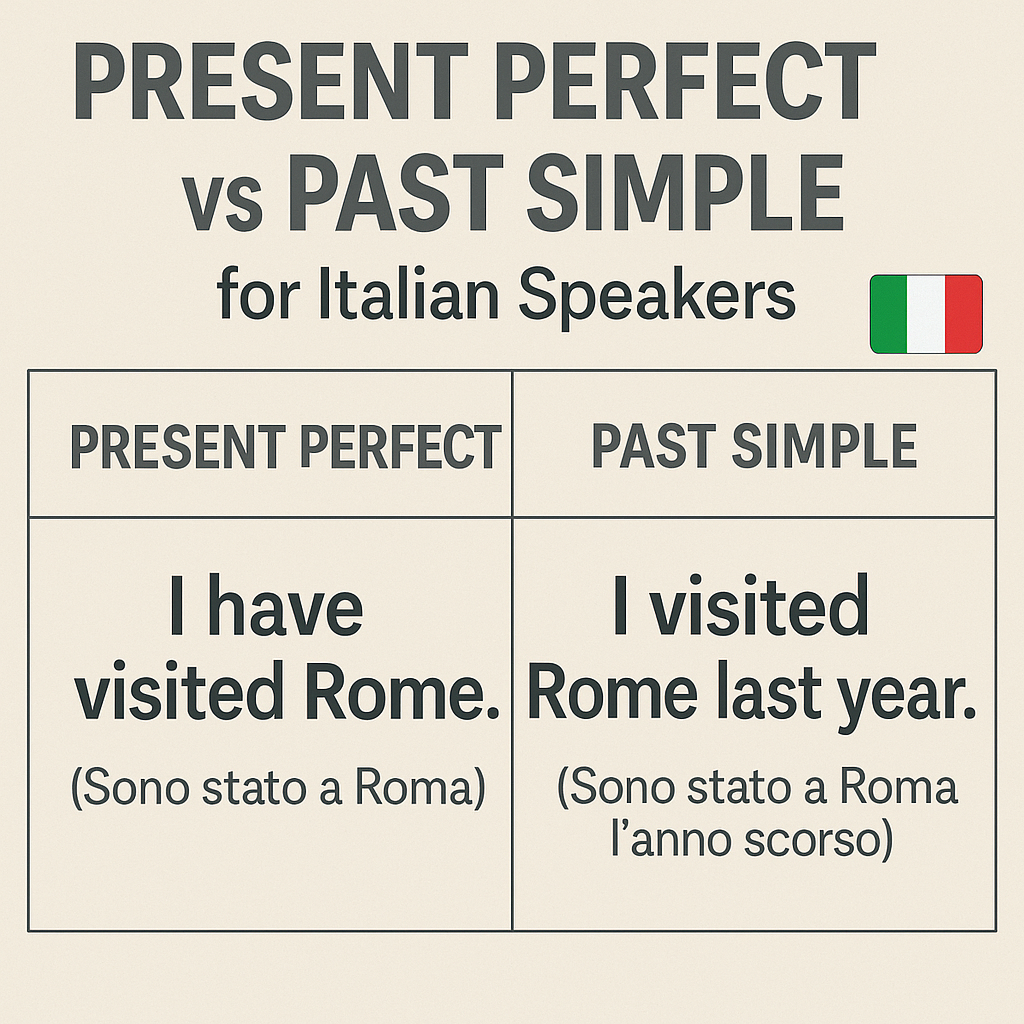
Listen to a short seminar about Past Simple & Present Perfect: consolidate your grammar and improve your listening skills
Past Simple vs Present Perfect: The Italian Learner’s Guide (A2)
You can read the seminar text here
📰 Past Simple vs Present Perfect: The Italian Learner’s Guide (A2)
Now Answer these Questions
Answer each question to reveal its explanation:
According to the seminar, when should you use Past Simple tense?
The trainer said Present Perfect is used for:
Which time expression requires Past Simple according to the seminar?
In the example ‘I have visited Rome’, why is Present Perfect used?
What does ‘I have lived in Milan for five years’ mean according to the seminar?
If you say ‘I lived in Milan for five years’ (Past Simple), what does this tell us?
According to the seminar, which words usually require Present Perfect?
What does the question ‘Did you eat lunch?’ ask about?
The seminar explained that ‘Have you eaten lunch?’ focuses on:
Why does ‘yesterday’ require Past Simple according to the trainer?
When should you use Present Perfect according to the principle of connection?
What does the ‘closed door’ metaphor represent?
The ‘open door’ metaphor for Present Perfect means:
What mistake do Italian speakers commonly make according to the seminar?
The trainer’s strategy for choosing the correct tense is to ask:
Grammar Focus: to struggle with
I know you’re struggling with Past Simple and Present Perfect.
In the phrase ‘struggling with Past Simple’, what does ‘struggle with’ mean?
Grammar Focus: to mess with (someone/something)
So you’ve got Passato Prossimo in your head, and it’s messing with you.
When the trainer says Passato Prossimo ‘is messing with you’, this means it:
Lexical Focus
to struggle with
“I know you’re struggling with Past Simple and Present Perfect.”
Pattern: verb + with + noun/gerund
Function: To express difficulty or challenge with something
Contrast with: to have difficulty with, to find something difficult
to mess with (someone/something)
“So you’ve got Passato Prossimo in your head, and it’s messing with you.”
Pattern: phrasal verb - informal
Function: To cause confusion or problems for someone
Contrast with: to confuse, to cause problems for