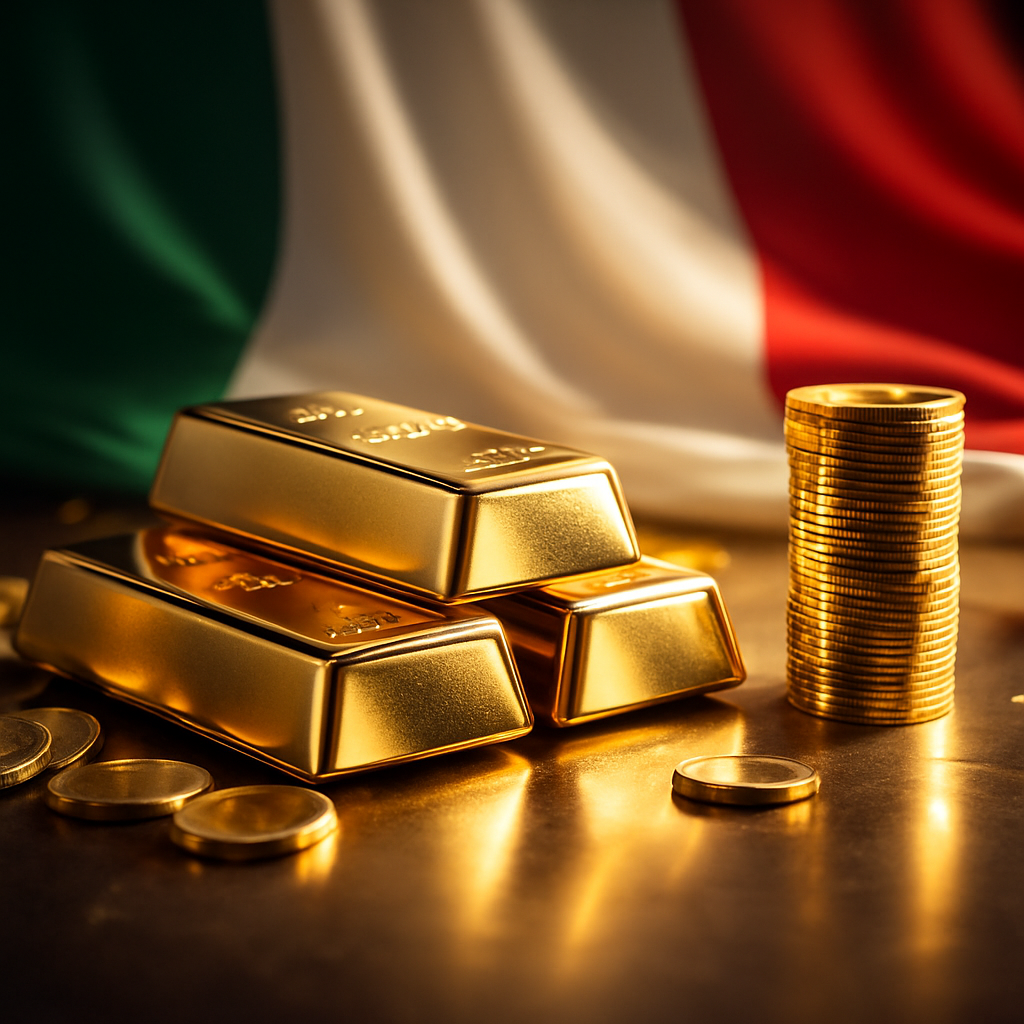
Why Italy Holds On to Its Gold
Deep beneath the Bank of Italy's headquarters, just a short walk from the Colosseum, sits a treasure worth three hundred billion dollars. Italy now holds the world's third-largest national gold reserve, behind only the United States and Germany. And despite mounting pressure to sell off some of this glittering stockpile, Italy refuses to let go.
🎧 Italy's Gold
Comprehension Check: Why Italy Refuses to Sell Its Gold
Answer the questions based on what you heard in the audio.
According to the audio, what is the value of Italy's gold reserves stored beneath the Bank of Italy?
What happened to Italy's gold reserves during World War Two?
Why does the audio suggest Italy guards its gold so fiercely today?
What percentage of Italy's official reserves does gold represent?
What is the main argument economists make against selling Italy's gold?
Which of these two summaries best captures the main points of the audio?
📰 Reading: Why Italy Refuses to Sell Its Gold (B1/B2)
Test Your Understanding & Learn Vocabulary
Answer each question to reveal its vocabulary explanation:
In the sentence 'Despite mounting pressure to sell off some of this glittering stockpile, Italy refuses to let go', what does 'sell off' mean?
What does 'glittering' mean?
In the sentence 'Despite mounting pressure to sell off some of this glittering stockpile, Italy refuses to let go', what does 'let go' mean?
In the sentence 'Italy's relationship with gold stretches back millennia', 'stretches back' indicates…
What does 'stems from' mean?
In the sentence 'During the postwar economic miracle, Italy bounced back dramatically', what does 'bounced back' mean?
'Poured in' could be replaced with which phrase?
In the sentence 'If other European countries had kept their gold reserves, they would be sitting on similar windfalls today', what does 'be sitting on' mean?
What does 'windfalls' mean?
In the sentence 'Today, gold makes up nearly seventy-five percent of Italy's official reserves', 'makes up' means…
“…selling even half the gold could help tackle Italy’s massive public debt,…” What does 'tackle' mean in this context?
In the sentence 'They point out that gold just sits there in vaults while schools and hospitals need funding', 'point out' means…
'Add up' in this context could be replaced with which phrase?
In the sentence 'Digital currencies are gaining ground', what does 'gaining ground' mean?
What does 'backing down' mean?
📚 Vocabulary Deep Dive
B1B2 – Lexical Cards Italy Gold
📖 Complete Vocabulary Reference
All vocabulary items organized by theme:
Financial Actions and Decisions
Phrasal verbs and expressions describing economic actions and policy choices
To sell something quickly, often at a lower price, especially assets or investments
📝 “The government decided to sell off state-owned companies to reduce debt.”
To release or stop holding something; to give up control or ownership of something
📝 “The company refused to let go of its most profitable division.”
To withdraw from a position or claim; to stop insisting on something
📝 “The minister refused to back down from his controversial policy.”
Recovery and Movement
Phrasal verbs describing economic recovery, growth, and flow of resources
To recover quickly from a difficult situation or setback
📝 “The economy bounced back after the recession ended.”
To arrive or enter in large quantities or numbers
📝 “Foreign investment poured in after the new tax reforms.”
To make progress or become more popular or accepted
📝 “Digital currencies are gaining ground among investors.”
Origins and Composition
Phrasal verbs describing historical origins and structural composition
To extend into the past; to have origins in an earlier time
📝 “The tradition stretches back over 500 years.”
To originate from or be caused by something
📝 “The current policy stems from decisions made decades ago.”
To form or constitute a part of something; to comprise
📝 “Gold makes up 75% of Italy's official reserves.”
Problem-Solving and Communication
Verbs and expressions related to addressing issues and conveying information
To deal with or try to solve a difficult problem
📝 “The government must tackle the rising unemployment rate.”
To direct attention to something; to mention or indicate something
📝 “Experts point out that the solution is more complex than it appears.”
To make sense; to seem reasonable or logical (often used in negative)
📝 “The numbers don't add up – something is wrong with the calculations.”
Descriptive and State Terms
Adjectives and expressions describing appearance, possession, and unexpected benefits
Shining with bright flashes of light; also used figuratively for something attractive or impressive
📝 “The glittering gold reserves attracted international attention.”
To possess something valuable without using or selling it
📝 “The company is sitting on millions in unused assets.”
Unexpected gains or pieces of good fortune, especially financial
📝 “The company enjoyed windfalls from the sudden increase in demand.”
🎮 Practice Activities
Word Formation
Complete the sentences using the correct form of the word in brackets
The company’s decision to _____ its assets helped reduce its debt significantly.
The _____ jewels in the vault attracted many potential buyers.
After years of struggle, the business finally _____ and became profitable again.
The tradition of _____ old belongings at year’s end is common in many cultures.
Foreign investors have been _____ in the local market over the past year.
The problem _____ a lack of communication between departments.
Gold _____ a significant portion of the country’s national reserves.
The government needs to _____ the economic crisis before it worsens.
Experts _____that the figures show a worrying trend.
The company is _____ valuable resources it hasn’t used yet.
Collocation Matching
Match each word with its most common partner
Gap Fill
Complete each sentence with the most appropriate word or phrase from the options
The tradition _____ hundreds of years to ancient times.
After the scandal, donations _____ to help the affected families.
The company enjoyed unexpected _____ when demand suddenly increased.
The minister refused to _____ despite strong criticism from opponents.
The numbers don't _____ – we need to check the calculations again.
The firm is _____ millions in unused property that could be sold.
The current economic problems _____ decisions made in the previous decade.
It's difficult to _____ of old habits, even when you know they're harmful.
Renewable energy is _____ as more countries invest in green technology.
Gap Fill Multiple Choice
Choose the correct word or phrase to complete each sentence
The government decided to _____ state-owned railways to private companies.
Analysts _____ that the recovery will take longer than expected.
The economy _____ quickly after the initial shock of the pandemic.
Women _____ only 30% of the total workforce in that sector.
The _____ display of wealth at the ceremony impressed all the guests.
The city needs to _____ the growing problem of traffic congestion.