Raise vs Rise: Mastering Two Confusing Verbs
Core PathWay
1 🌐 Introduction: Why Raise and Rise Cause Confusion
Raise and rise look similar, sound similar, and even share related meanings – but they behave very differently in sentences. This causes problems for learners at all levels. The key difference is grammatical: raise is a transitive verb (it needs an object – you raise *something*), while rise is intransitive (it happens by itself, with no object). This distinction affects everything from how you form sentences to which collocations sound natural. Understanding these verbs unlocks dozens of common expressions in business, everyday conversation, and idiomatic English. Both verbs relate to upward movement or increase, but choosing the wrong one makes your English sound unnatural, even when your meaning is clear.
💬 Dialogue 1: Salary Discussion at Work
An employee talks to their manager about pay during an annual review meeting
2 🔍 Lexical Breakdown: Core Meanings and Uses
RAISE (transitive – always needs an object)
Meaning 1: To lift something up or move it to a higher position
Simple definition: To move something up or put it in a higher place.
– *She raised her hand to ask a question.*
– *Please raise the window blinds – it’s too dark in here.*
– *The builders raised the roof by two metres.*
Register: Neutral – works in all contexts.
Meaning 2: To increase an amount, level, or standard
Simple definition: To make something bigger, higher, or more.
– *The company raised salaries by 5% this year.*
– *We need to raise our standards if we want to compete.*
– *The government raised taxes on luxury goods.*
Register: Neutral – common in business and formal contexts.
Meaning 3: To bring up a topic or mention something
Simple definition: To talk about something or bring it into a conversation or meeting.
– *I’d like to raise an important issue at tomorrow’s meeting.*
– *Nobody wanted to raise the question of budget cuts.*
– *She raised several concerns about the new policy.*
Register: Neutral to formal – especially common in professional settings.
Meaning 4: To collect money or resources
Simple definition: To get money from people for a special purpose.
– *The charity raised over £50,000 for children’s hospitals.*
– *We’re raising funds to build a new community centre.*
– *They raised enough money to start the business.*
Register: Neutral – common in charity and business contexts.
Meaning 5: To care for children or animals until they are adults
Simple definition: To take care of children or young animals as they grow up.
– *They raised three children in a small apartment.*
– *She was raised by her grandparents in the countryside.*
– *It’s expensive to raise a family in London.*
Register: Neutral – everyday use.
—
RISE (intransitive – never takes an object)
Meaning 1: To move upward or go up
Simple definition: To go up or move to a higher place (by itself, not because someone moves it).
– *The sun rises in the east every morning.*
– *Smoke was rising from the chimney.*
– *The balloon rose slowly into the sky.*
Register: Neutral – works in all contexts.
Meaning 2: To increase in amount, number, or level
Simple definition: To become bigger, higher, or more.
– *Temperatures rise significantly in summer.*
– *House prices have risen by 15% in the last year.*
– *Unemployment rose sharply during the recession.*
Register: Neutral – common in news, reports, and formal writing.
Meaning 3: To stand up or get up
Simple definition: To move from sitting or lying to a standing position.
– *Everyone rose when the judge entered the courtroom.*
– *He rose from his chair to greet the visitors.*
– *She rose early to catch the first train.*
Register: Formal – in everyday speech, people usually say “get up” or “stand up”.
Meaning 4: To become more powerful or successful
Simple definition: To become more important, powerful, or successful.
– *She rose quickly through the company ranks.*
– *Napoleon rose to power in the early 1800s.*
– *New political movements are rising across Europe.*
Register: Neutral to formal – common in historical and political contexts.
Meaning 5: To respond to a challenge or difficult situation
Simple definition: To deal with a difficult situation successfully.
– *The team rose to the challenge and won the championship.*
– *She always rises to the occasion when things get tough.*
– *Will he rise above the criticism and continue his work?*
Register: Neutral – often used in motivational or evaluative contexts.
💬 Dialogue 2: Baking Bread Together
Two friends are baking bread at home and discussing the process
3 📚 Word Family and Variants
RAISE Word Family
Verb: raise (base form), raised (past simple and past participle), raising (present participle)
– *They raise concerns regularly.*
– *She raised the issue yesterday.*
– *We are raising money for charity.*
Noun: raise (American English – means a salary increase)
– *I got a raise of $5,000 this year.* (US)
– Note: In British English, people say “pay rise” instead of “raise”.
Noun: raising (the act of bringing something up or increasing it)
– *The raising of awareness is crucial for this campaign.*
– *Child-raising requires patience and commitment.*
Related forms and common combinations:
– fundraising (noun/adjective) – the activity of collecting money for a cause
– *We’re organizing a fundraising event next month.*
– fundraiser (noun) – a person who collects money, or an event for collecting money
– *She works as a professional fundraiser for charities.*
– *The school fundraiser was very successful.*
—
RISE Word Family
Verb: rise (base form), rose (past simple), risen (past participle), rising (present participle)
– *Prices rise every year.*
– *The temperature rose to 35 degrees yesterday.*
– *Costs have risen dramatically since 2020.*
– *The rising cost of living worries many families.*
Noun: rise (an increase or upward movement)
– *There’s been a sharp rise in energy costs.*
– *The rise of social media changed communication forever.*
– *We watched the rise and fall of the waves.*
Adjective: rising (increasing or becoming more important)
– *She’s a rising star in the music industry.*
– *Rising unemployment is a serious concern.*
– *The rising sun painted the sky orange.*
Related forms:
– sunrise (noun) – when the sun comes up in the morning
– *We woke up at sunrise to start the hike.*
– high-rise (noun/adjective) – a very tall building
– *They live in a high-rise apartment building.*
– uprising (noun) – when people fight against authority or government
– *The uprising was quickly suppressed by the military.*
💬 Dialogue 3: Discussing Company Performance
Two colleagues review quarterly business results in an office meeting
4 🔗 Collocations and Combinations
Strong Collocations with RAISE
raise + awareness
Meaning: To make more people know about something important.
– *The campaign aims to raise awareness about mental health issues.*
– *We need to raise awareness of climate change in schools.*
raise + money/funds
Meaning: To collect money for a purpose.
– *They’re raising funds to build a new hospital wing.*
– *The concert raised money for disaster relief.*
raise + question/issue/concern
Meaning: To bring up a topic that needs discussion.
– *This report raises questions about the company’s finances.*
– *Several employees have raised concerns about workplace safety.*
raise + voice
Meaning: To speak louder or to express an opinion.
– *You don’t need to raise your voice – I can hear you perfectly.*
– *More citizens are raising their voices against the new law.*
raise + standards
Meaning: To make the quality or level better.
– *The school has raised standards significantly in recent years.*
– *We must raise standards if we want to stay competitive.*
raise + prices/taxes/rates
Meaning: To increase the cost of something.
– *The restaurant raised prices by 10% last month.*
– *The government plans to raise taxes on tobacco products.*
raise + a family
Meaning: To bring up children.
– *They moved to the suburbs to raise a family.*
– *It’s challenging to raise a family on a single income.*
raise + eyebrows
Meaning: To cause surprise or mild shock.
– *His expensive lifestyle raised eyebrows among colleagues.*
– *The appointment of such a young CEO raised eyebrows in the industry.*
—
Strong Collocations with RISE
prices/costs/temperatures + rise
Meaning: These things go up or increase.
– *Food prices rise faster than wages in many countries.*
– *Global temperatures are rising due to climate change.*
sun/moon + rises
Meaning: When these appear in the sky.
– *The sun rises around 6 AM in summer.*
– *We watched the moon rise over the mountains.*
rise + to power
Meaning: To become powerful or gain control.
– *Hitler rose to power in Germany in the 1930s.*
– *She rose to power through years of political networking.*
rise + to the occasion/challenge
Meaning: To perform well in a difficult situation.
– *Despite the pressure, the team rose to the occasion and won.*
– *I’m confident you’ll rise to the challenge of this new role.*
rise + above (something)
Meaning: To not let something negative affect you.
– *She rose above the criticism and continued her work.*
– *True leaders rise above petty disputes.*
rise + through the ranks
Meaning: To advance in an organization or career.
– *He rose through the ranks from intern to CEO in 15 years.*
– *She rose through the ranks of the military to become a general.*
on the rise
Meaning: Increasing or becoming more common.
– *Crime is on the rise in urban areas.*
– *Plant-based diets are on the rise among young people.*
give rise to (something)
Meaning: To cause something to happen or exist.
– *The scandal gave rise to calls for the minister’s resignation.*
– *New technology often gives rise to unexpected social changes.*
5 🤔 Metaphors & Idioms
Both raise and rise appear in many metaphorical expressions that native speakers use naturally. Understanding these idioms helps with comprehension, though learners should be careful about using them in speaking and writing until they’re confident about context and register.
raise the bar – to set a higher standard that others must reach
– *Her performance really raised the bar for future candidates.*
raise hell – to complain angrily and cause trouble (informal)
– *When they cancelled the concert, fans raised hell on social media.*
raise the roof – to make a lot of noise through cheering or celebrating
– *The crowd raised the roof when the home team scored.*
raise Cain – to cause trouble or create a disturbance (old-fashioned)
– *The kids were raising Cain while their parents were out.*
get a rise out of someone – to deliberately annoy someone to get a reaction
– *He’s just trying to get a rise out of you – ignore him.*
rise and shine – a cheerful way to tell someone to wake up (informal)
– *Come on, rise and shine! We’re leaving in 30 minutes.*
rise from the ashes – to become successful again after failure or destruction
– *The company rose from the ashes after bankruptcy and is now thriving.*
a rising tide lifts all boats – when conditions improve, everyone benefits
– *Economic growth is good for everyone – a rising tide lifts all boats.*
rising star – someone who is becoming successful and famous
– *She’s a rising star in the world of contemporary art.*
the sun rises and sets on someone – to think someone is perfect (usually about a child)
– *For her grandparents, the sun rises and sets on that little girl.*
Member-Exclusive Vocabulary Review & Acquisition System
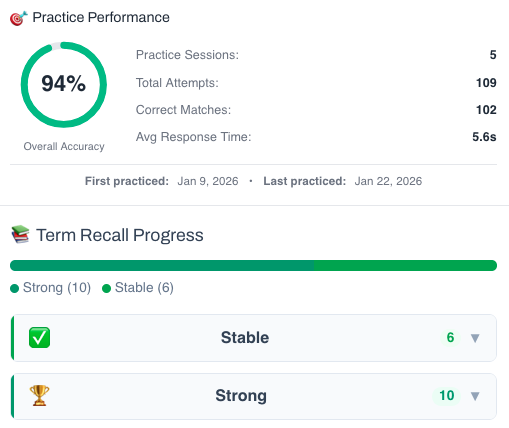
This isn’t a simple quiz — it’s a fully tracked learning system. You build knowledge through recognition, then recall, and your progress feeds directly into the Integrated Practice Bar (Writing tasks, AI Chat, and more).
- Practice sessions, accuracy, and response-time tracking
- Term strength levels (Learning → Stable → Strong)
- Personal progress history for each unit
This feature is available to YSP members.
Explore Membership Benefits