Understanding the Difference: Raise vs Rise
📖 Reading time: 12 minutes | Level: B1-B2
Why This Matters
Confusing 'raise' and 'rise' is one of the most common mistakes English learners make, and it can make your writing sound unprofessional or unclear. The key difference is simple but crucial: 'raise' requires an object (someone raises something), while 'rise' doesn't (something rises by itself). This matters in business emails when discussing salary increases, in news articles about economic trends, and in everyday conversations about prices and temperatures. Using the wrong word can change your meaning completely—saying 'prices raised' suggests someone actively increased them, while 'prices rose' means they went up naturally. Mastering this distinction will make your English sound more natural and accurate, especially in professional contexts.
⚠️ Common Mistakes:
- Using 'raised' instead of 'risen' as the past participle (e.g., 'Temperatures have raised' instead of 'have risen')
- Using 'rise' with an object when you need 'raise' (e.g., 'The government will rise taxes' instead of 'raise taxes')
- Using 'raise' without an object when you need 'rise' (e.g., 'Prices raised' instead of 'Prices rose')
- Mixing up the past tense forms 'raised' and 'rose' (e.g., 'The sun raised at 6 AM' instead of 'rose')
🎯 By the end of this lesson, you'll be able to confidently choose between 'raise' and 'rise' in any context, use their correct verb forms, and understand which collocations work with each word.
📚 Deep Dives
Deep Dive: Raise
Core meaning: To lift or move something to a higher position; to increase an amount or level; to collect money; to bring up children. Always requires an object—someone raises something.
📖 Grammar
“She got a 5% raise after her performance review.”
Countable noun, primarily American English for salary increase. British English uses 'rise'.
🔗 Common Collocations
Deep Dive: Rise
Core meaning: To move upward or increase without external force; to get up from sitting or lying; an upward movement or increase in level or amount. Never takes an object—things rise by themselves.
📖 Grammar
“There has been a sharp rise in energy costs this winter.”
Countable noun. 'Pay rise' is British English; Americans say 'raise'.
🔗 Common Collocations
Practice: Choose the Correct Expression
Read each sentence carefully and select the most appropriate word to complete it. Pay attention to whether there's an object (something being acted upon) or not.
Gas prices have _____ by 15% since last month.
The government plans to _____ taxes on luxury goods next year.
We need to _____ awareness about climate change in our community.
The temperature has _____ significantly over the past decade.
The company has _____ its prices three times this year.
The sun _____ at 6:30 AM during summer.
Please _____ your hand if you have any questions.
The charity event helped _____ funds for the children's hospital.
Food costs have been _____ steadily for months.
The report _____ several important concerns about safety.
The company's stock value _____ dramatically after the merger was announced.
Scientists have _____ the alarm about rising sea levels.
Unemployment rates continue to _____ in the manufacturing sector.
The manager decided to _____ everyone's salary by 3%.
Water levels have _____ to dangerous heights after the storm.
The campaign successfully _____ public awareness about the issue.
📝 Connected Practice Passages
Passage 1
🔑 Key Learning: Notice the difference: 'salary raise' (noun, American), 'risen to challenges' (idiom), and 'has risen by 8%' (intransitive verb with percentage change).
Passage 2
🔑 Key Learning: This passage shows all the key distinctions: government raises taxes (transitive), inflation has risen (intransitive), experts raised concerns (collocation), rates continue to rise (intransitive).
Passage 3
🔑 Key Learning: Conversational contexts use both verbs naturally: company raises salaries (transitive), rent has risen (intransitive), everything is rising (intransitive continuous), raise a glass (idiom).
Passage 4
🔑 Key Learning: Academic writing requires precision: temperatures rise (intransitive), scientists raised the alarm (collocation), governments must raise awareness (collocation), sea levels will rise (intransitive).
🎯 Using Them Together
The key to choosing correctly is asking: 'Is someone doing this TO something (raise), or is it happening by itself (rise)?' Here's how to decide:
Decision Flowchart
Example Using All Terms:
The company decided to RAISE prices after costs ROSE by 15%. This decision RAISED concerns among customers, and tensions began to RISE. The CEO tried to RAISE awareness about the reasons, explaining that supplier prices had RISEN dramatically. Despite attempts to RAISE morale, employee satisfaction continued to RISE and fall unpredictably. The board will RISE to the occasion and address these challenges.
Why Each Term Works:
- RAISE prices: transitive—company is doing it to prices
- costs ROSE: intransitive—costs went up by themselves
- RAISED concerns: fixed collocation—transitive
- tensions began to RISE: intransitive—happened naturally
- RAISE awareness: fixed collocation—transitive
- prices had RISEN: intransitive past perfect—autonomous increase
- RAISE morale: transitive—trying to increase it
- satisfaction continued to RISE: intransitive—happening by itself
- RISE to the occasion: fixed idiom
Quick Reference Card
Member-Exclusive Vocabulary Review & Acquisition System
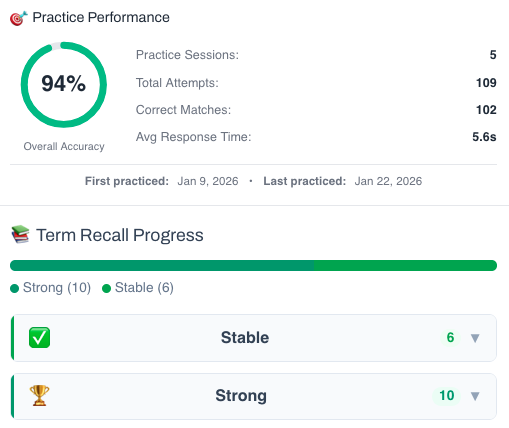
This isn’t a simple quiz — it’s a fully tracked learning system. You build knowledge through recognition, then recall, and your progress feeds directly into the Integrated Practice Bar (Writing tasks, AI Chat, and more).
- Practice sessions, accuracy, and response-time tracking
- Term strength levels (Learning → Stable → Strong)
- Personal progress history for each unit
This feature is available to YSP members.
Explore Membership Benefits