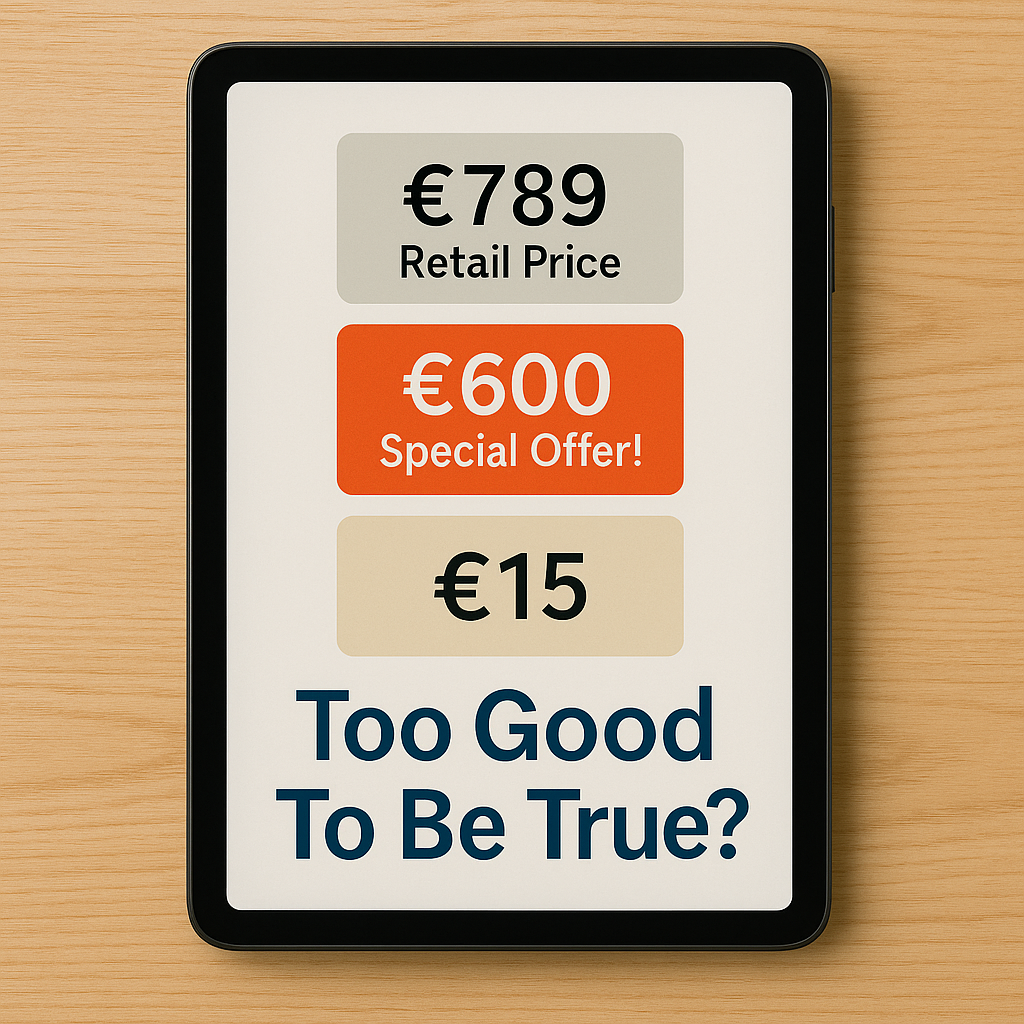
Too Good A Deal
Imagine this: you're scrolling through an electronics retailer's website during Black Friday season, and you spot a premium tablet. It normally costs around a thousand dollars, but it's listed for just seventeen dollars. This isn't a typo in the advertisement—it's the actual checkout price. Do you click buy? And if you do, can the company take it back later?
🔍 Listening Focus Questions
When a Deal Seems Too Good to Be True
Want to focus on some specifics while you listen? Read these questions before you press play.
- According to the audio, what was the normal price of the tablet?
- How long after buying the tablets did customers get the email about the mistake?
- What two choices did the shop give customers after the mistake?
- Why does the audio say big discounts are harder to recognize as mistakes today?
- According to the audio, why is buying five tablets different from buying one?
🎧 Too Good A Deal A2 Part 1
🎧 Too Good A Deal A2 Part 2
Comprehension Check: When a Deal Seems Too Good to Be True
Answer the questions based on what you heard in the audio.
According to the audio, what was the normal price of the tablet?
How long after buying the tablets did customers get the email about the mistake?
What two choices did the shop give customers after the mistake?
Why does the audio say big discounts are harder to recognize as mistakes today?
According to the audio, why is buying five tablets different from buying one?
Which of these two summaries best captures the main points of the audio?
📰 When a Deal Seems Too Good to Be True (A2)
Test Your Understanding & Learn Vocabulary
Answer each question to reveal its vocabulary explanation:
In the sentence ‘You spot a tablet computer on the website’, what does ‘spot’ mean?
What is the ‘checkout price’?
When a shop can ‘take back’ something, it means the shop can…
What is a ‘deal’ in shopping?
In the sentence ‘Within one hour, they got confirmation emails’, ‘within’ means…
When workers ‘handed over’ the tablets, they…
What is a ‘retailer’?
In the sentence ‘Second choice: return the tablet and get a refund’, what is a ‘refund’?
What is a ‘voucher’?
If a price is ‘binding’, it…
In the sentence ‘And the other person can reasonably see the mistake’, ‘reasonably’ means…
What is ‘awareness’?
When someone ‘spots the deal’, they…
In the sentence ‘The case is interesting because it is in a gray area’, what does ‘gray area’ mean?
What does ‘middle ground’ mean?
📚 Vocabulary Deep Dive
A2 – Too Good To Be True
📖 Complete Vocabulary Reference
All vocabulary items organized by theme:
Shopping Transaction Terms
Words related to purchasing, pricing, and retail exchanges
to notice or see something, especially something that is difficult to see
📝 “I spotted a great deal on shoes at the store yesterday.”
the final price you pay for something at the cash register
📝 “The checkout price was different from the price on the shelf.”
a good price for something; an agreement to buy or sell something
📝 “I got a great deal on this laptop – 50% off!”
a business or person that sells products directly to customers
📝 “The retailer refused to give me a refund without a receipt.”
Returns and Money Back Terms
Vocabulary for returning items and getting money back
to return something you bought to the store
📝 “I need to take this shirt back because it doesn't fit.”
money that is given back to you when you return something
📝 “The store gave me a full refund when I returned the broken phone.”
a piece of paper or code that can be used instead of money to pay for something
📝 “Instead of cash, they gave me a voucher to use in the store.”
gave something to someone
📝 “I handed over my credit card to pay for the items.”
Legal and Obligation Terms
Words describing rules, obligations, and legal requirements
something that must be obeyed or followed; legally required
📝 “The price on the shelf is not legally binding in all countries.”
inside a particular period of time or limits
📝 “You must return the item within 30 days to get your money back.”
in a fair and sensible way; to an acceptable degree
📝 “The store should reasonably honor the advertised price.”
knowledge or understanding of a situation or subject
📝 “Consumer awareness of their rights is very important.”
Ambiguity and Compromise Terms
Expressions describing unclear situations and middle positions
a situation where the rules are not clear; something uncertain
📝 “Pricing mistakes are a gray area in consumer law.”
a compromise position between two opposite opinions or situations
📝 “The store and customer found a middle ground by offering a voucher.”
🎮 Practice Activities
Word Formation
Complete the sentences using the correct form of the word in brackets
The store is a major _______ of electronics in this city.
Public _______ of consumer rights has increased in recent years.
The manager _______ agreed to give me a voucher instead of cash.
Is this item _______? I might want to return it.
The contract is legally _______ on both the buyer and seller.
Collocation Matching
Match the words on the left with their common partners on the right
Gap Fill
Complete each sentence with the correct word or phrase from the box
I _______ a pricing error on the shelf, so I asked the manager about it.
The shoes didn't fit, so I decided to _______ to the store the next day.
You must return the item _______ 30 days to receive your money back.
The store gave me a _______ instead of cash, which I could use for future purchases.
After some discussion, we found a _______ that satisfied both me and the store manager.
Gap Fill Multiple Choice
Choose the correct option to complete each sentence
Error Correction
Find and correct the mistake in each sentence
❌ I spotted to a pricing mistake on the label.
❌ The retailer shop refused to give me a refund.
❌ I took back it to the store yesterday.
❌ You must return the item in 14 days for a full refund.
❌ I have awareness about my consumer rights.