Attend Something vs Attend To Something: A Complete Guide
Core PathWay
1 The Big Difference: One Little Word Changes Everything
Here’s something that confuses many English learners: the verb attend completely changes its meaning when you add the tiny word to.
Attend something = go to an event or participate in an activity
– I attend a meeting every Monday morning.
– She attends university in London.
– Did you attend the conference last week?
Attend to something = deal with a problem or look after a task
– The manager needs to attend to a problem with the client.
– Can you attend to this urgent matter?
– I’ll attend to your request immediately.
The difference is huge! If your boss says ‘Please attend the meeting’, you need to go there. But if they say ‘Please attend to this problem’, you need to solve it or take care of it.
💬 Dialogue 1: Scheduling Conflicts
Two colleagues discussing their busy schedules and priorities
2 Attend Something: Going Places and Joining Activities
When we use attend something (without ‘to’), we’re talking about being present at an event or activity. This is similar to go to or participate in, but sounds more formal.
Common things we attend:
– Attend a meeting (go to a meeting)
– Attend a class or course
– Attend a conference or seminar
– Attend a wedding or funeral
– Attend an appointment
– Attend university or school
Examples in context:
– ‘I have to attend a meeting at 3 PM today.’
– ‘How many people attended the training session?’
– ‘She attends yoga classes twice a week.’
– ‘Will you attend the presentation tomorrow?’
💬 Dialogue 2: Training Session Dilemma
Two coworkers discussing whether to attend a training session
3 Attend To Something: Dealing With Problems and Taking Care of Tasks
When we use attend to something (with ‘to’), we mean giving something our attention, care, or action. This is similar to deal with or look after.
Common things we attend to:
– Attend to a problem (solve or fix it)
– Attend to an urgent matter
– Attend to a customer or client
– Attend to someone’s needs
– Attend to the details
– Attend to your responsibilities
Examples in context:
– ‘The receptionist will attend to you in a moment.’ (help you, serve you)
– ‘I need to attend to this issue before I leave.’ (deal with this problem)
– ‘Can you attend to the client’s request?’ (take care of what the client needs)
– ‘She’s attending to an urgent situation right now.’ (handling an emergency)
4 Common Mistakes to Avoid
Many learners mix up these two forms. Here are the most common mistakes:
❌ ‘I need to attend the problem.’ → ✓ ‘I need to attend to the problem.’
❌ ‘She attends to meetings every day.’ → ✓ ‘She attends meetings every day.’
❌ ‘Can you attend my question?’ → ✓ ‘Can you attend to my question?’ (or better: ‘Can you answer my question?’)
❌ ‘I attended to the conference.’ → ✓ ‘I attended the conference.’
Remember:
– Events, activities, places → attend (no ‘to’)
– Problems, tasks, needs → attend to
5 Practice Dialogue 1: At the Office
See how both forms work in a real workplace conversation:
Maya: Tom, are you free this afternoon?
Tom: I have to attend a meeting at 2 PM, but I’m free after that. Why?
Maya: There’s an urgent problem with the Johnson account. Someone needs to attend to it today.
Tom: What kind of issue is it?
Maya: They’re unhappy with the delay in their order. Can you deal with it after your meeting?
Tom: Sure, I’ll attend to it as soon as the meeting finishes. Should I call them or visit their office?
Maya: A phone call should be enough. Just make sure you handle their concerns carefully.
Tom: No problem. I’ll take care of it this afternoon.
6 Practice Dialogue 2: Making Plans
Here’s how these phrases work in a more casual context:
Sarah: Are you going to the training session on Friday?
Jake: Which one? I have to attend two different sessions this week.
Sarah: The one about customer service. I think it’s at 10 AM.
Jake: Oh, I can’t attend that one. I have to attend to some urgent emails from clients in the morning.
Sarah: Can’t someone else look after those emails?
Jake: Not really. They’re my responsibility. But I’ll participate in the afternoon session instead.
Sarah: There isn’t an afternoon session. Maybe you should ask your manager which is more important.
Jake: Good idea. I’ll deal with that now and see what she says.
7 Using Synonyms Naturally
While attend and attend to are useful, native speakers often use simpler alternatives in everyday conversation. Here’s when to use each:
For events and activities:
– Formal: ‘I’ll attend the conference.’ (business emails, official communication)
– Neutral: ‘I’m going to the conference.’ (everyday speech)
– Active: ‘I’ll participate in the conference.’
For problems and tasks:
– Formal: ‘I’ll attend to this matter.’ (business writing, professional contexts)
– Common: ‘I’ll deal with this problem.’ (most common in speech)
– Caring: ‘I’ll look after this for you.’ (when helping someone)
– Casual: ‘I’ll handle it.’ or ‘I’ll take care of it.’ (friendly, reassuring)
8 Your Turn: Quick Practice
Choose the correct form for each situation:
1. ‘I need to _____ the weekly team meeting.’ (attend / attend to)
2. ‘Can you _____ this customer complaint?’ (attend / attend to)
3. ‘She _____ university in Manchester.’ (attends / attends to)
4. ‘The doctor will _____ you shortly.’ (attend / attend to)
5. ‘How many people _____ the wedding?’ (attended / attended to)
Answers:
1. attend (it’s an event you go to)
2. attend to (it’s a problem you need to deal with)
3. attends (university is a place you go to)
4. attend to (the doctor will help you, look after you)
5. attended (a wedding is an event)
Member-Exclusive Vocabulary Review & Acquisition System
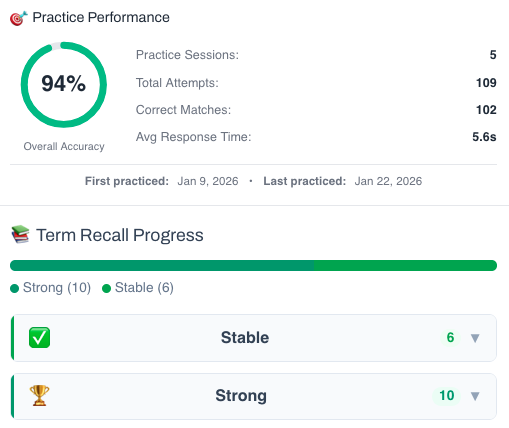
This isn’t a simple quiz — it’s a fully tracked learning system. You build knowledge through recognition, then recall, and your progress feeds directly into the Integrated Practice Bar (Writing tasks, AI Chat, and more).
- Practice sessions, accuracy, and response-time tracking
- Term strength levels (Learning → Stable → Strong)
- Personal progress history for each unit
This feature is available to YSP members.
Explore Membership Benefits