Emma had been working on her novel for months, but progress was painfully slow. She had been writing all day, but she had only written three pages. As she stared at her laptop screen, she wondered why writing had become so difficult when it used to be her greatest joy.
The story focuses on Past Simple, Past Continuous, Past Perfect Simple, Past Perfect Continuous & Used to
🎧 Emma's Novel
🎧 Emma's Novel – Slower Version
Read the story for a more detailed understanding
📖 The Novel That Wouldn’t Come (B1/B2)
Grammar Investigation
Answer each question to reveal the grammar explanation:
Her phone rang.
In the sentence ‘Her phone rang’, why do we use Past Simple?
So she had quit her job in January and had started working on her book.
Why do we use Past Perfect in ‘she had quit her job in January’ when the story is already in the past?
Emma had been working on her novel for months, but progress was painfully slow.
Why does the story say ‘Emma had been working on her novel for months’ instead of ‘Emma was working on her novel for months’?
The rain was falling heavily outside.
What does Past Continuous show in ‘The rain was falling heavily outside’?
She used to write for hours without stopping.
Why do we say ‘She used to write for hours’ instead of ‘She wrote for hours’?
📚 Grammar Reference
PAST SIMPLE
Structure: regular verbs: base + -ed; irregular verbs: unique past form
Pattern: subject + verb (past form)
What it expresses: Completed actions and events in the past that moved the story forward
When to use: For main narrative events in sequence, completed actions at specific past times, and actions that interrupt ongoing situations
Why this form: Past simple creates the backbone of narrative, showing what happened in chronological order
Examples in story: 15
PAST PERFECT SIMPLE
Structure: had + past participle
Pattern: subject + had + past participle
What it expresses: Actions or states completed before another past time or before the main story time
When to use: To show that one past action happened before another past action, to give background information about earlier events, to explain past situations
Why this form: Creates a clear time sequence showing which past event came first
Examples in story: 11
PAST PERFECT CONTINUOUS
Structure: had been + verb-ing
Pattern: subject + had been + present participle
What it expresses: Ongoing actions or situations over a period of time before a past reference point, often showing duration or explaining a past result
When to use: To emphasize duration of an action before a past moment, to show gradual change over time in the past, to explain why a past situation existed
Why this form: Emphasizes the continuous nature and duration of the action before the past reference point
Examples in story: 11
PAST CONTINUOUS
Structure: was/were + verb-ing
Pattern: subject + was/were + present participle
What it expresses: Ongoing actions or situations at a specific moment in the past, background actions in narrative, temporary situations in the past
When to use: To describe what was happening at a specific past moment, to set the scene in a narrative, to show an action in progress when something else happened
Why this form: Creates atmosphere and background, showing actions in progress rather than completed
Examples in story: 8
USED TO
Structure: used to + base verb
Pattern: subject + used to + infinitive (without ‘to’)
What it expresses: Past habits or states that are no longer true, contrasting past with present
When to use: To describe regular past actions that don’t happen now, to describe past states that have changed, to emphasize the contrast between past and present
Why this form: Specifically shows that something was true in the past but is not true now
Examples in story: 8
Extra Grammar Note
↳ Additional Information
⚖️ WILL vs WOULD: Present Decisions vs Past Narrative
YSP Members can take the graded quiz – quiz scores are available on your Member Dashboard
Non Members can take quiz – scores are not tracked
Which sentence correctly uses the past simple?
Complete the sentence with the correct form: “When I arrived at the party, everyone _______ already.”
In this sentence, the past continuous is used to express: “While I was studying, my brother was playing video games.”
Which sentence contains an error with narrative tenses?
Which sentence correctly uses “used to”?
What does the past perfect continuous indicate in this sentence: “She had been working there for ten years before she got promoted.”
Choose the sentence that best completes this story: “Tom looked tired. He _______.”
Which sentence is correct?
What is wrong with this sentence: “I used to went to that school when I was a child.”
Why is the past continuous used in this sentence instead of the past simple: “At 8 PM yesterday, I was having dinner with my family.”
Complete the sentence: “The ground was wet because it _______.”
Which sentence contains an error?
In which situation would you use the past perfect?
Choose the most appropriate response: “Why were you so tired yesterday?” “_______”
Choose the corrected version of this sentence: “While I drove to work, I was seeing an accident.”
Use the VAS to build solid recognition and recall of the terms below.
✔ Every correct Match = +1 point
✔ Every correct Recall = +2 points
🎓 Reach 5 points with good accuracy and the term is automatically promoted to your Personal Dictionary.
Incorrect answers lower accuracy, meaning more correct Matches or Recalls may be needed to reach promotion.
Member-Exclusive Vocabulary Review & Acquisition System
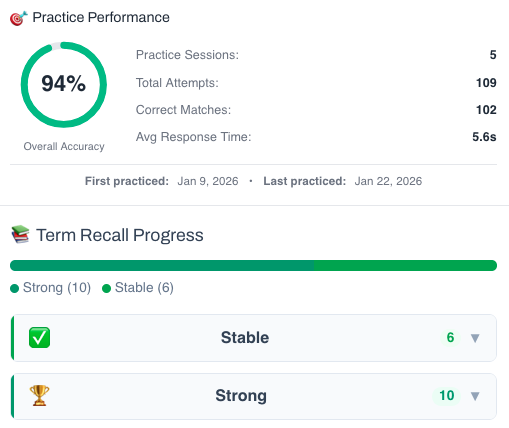
This isn’t a simple quiz — it’s a fully tracked learning system. You build knowledge through recognition, then recall, and your progress feeds directly into the Integrated Practice Bar (Writing tasks, AI Chat, and more).
- Practice sessions, accuracy, and response-time tracking
- Term strength levels (Learning → Stable → Strong)
- Personal progress history for each unit
This feature is available to YSP members.
Explore Membership Benefits